
NOTE: This info is copyright and must not be used for commercial purposes by any other party. Chris Kinman © 1998.
Here are some tips on achieving more performance from your trusty guitar and for those of you who are about to embark on putting a project guitar together from parts. I amassed the knowledge displayed on this page over the course of many years I have spent in the guitar industry.
How to age Kinman Strat covers
The rogue 3rd string
Magnets the differences between Alnico, Ceramic and Samarium Cobalt
Body woods
Neck woods
Neck construction
Sustain (plus Live & Dead notes)
Harmonic nodes and pickup placement
Fretboard radius
Fretboard woods
Pickup Covers
Removing covers
Switches
Pots - all about them
Tone control capacitors
VOLUME control control (Treble by-pass filter)
Soldering tricks n tips (different page)
Magnet/String alignment improved
Mixing different brands of pickups (new Jan-08)
Mixing Single coils with a Humbucker
Phase (or output polarity) test method (new Jan-08)
Shielding for newer guitars
Shielding for older guitars with vintage value
Irritating scratchy noises
Keeping it in TUNE
Strat Bridge topics (IMPORTANT)
A simple experiment with Twin Pivot bridges
Retrofitting a Traditional Strat bridge
Strings - my experiences
How to age Kinman Strat covers
Click here to learn how to remove covers safetly from Kinman Strat* pickups
You can order your pickups with White covers pre-tinted from my factory for an additional cost. Other colours are molded with the colour and so are permanent and non-bleachable colours.
DIY tinting of White covers: Kinman's current White Strat pickup covers are molded in a special plastic that can be semi-permanently tinted with water based dies such as Tea, Coffee, Curry, Henna hair dye etc. Some colours that can be made this way are .......
You simply degrease the White covers first with strong kitchen or laundry detergent or lighter fluid and then soak the White covers in the above (boiling temperature) food solutions for anything from 10 seconds up to several minutes (check the colour every 20 seconds until it's satisfactory). There is no need to keep the solution on the boil. If stronger colour is desired simply allow more time, up to several minutes. If the colour is still not strong enough than add more coffee/tea/stain. If you make a mistake then reverse the process by soaking the cover in Laundry bleach and start over. The resulting colours may change with time and exposure to light.
Do not attempt this with very old Kinman ABS covers as they will simply melt. The old covers can be identified by the notch taken out of the bottom of the cover, in other words the bottoms of those covers are split into two planes.
Caution: we can not guarantee all covers that have Logo will stain satisfactorily as the stain might not work due to the application of a conditioner intended to allow the logo to stick. In this case the covers can be reverted to original color by bleaching as above. Covers without Logo will stain without difficulty.
Covers are Standard with Burgandy printed Ink logo. Covers are also available without Kinman logo by special request (with an upcharge). Logos sometimes wear off the covers and will leave a white witness mark if the covers are tinted after the logo is printed.
The new covers also do not have sharp edges at the top (but it's not rounded over noticeably), covers the lower coil completely and is more flexible than the previous cover. These new covers conform to early Fender specs in every way so it's no longer necessary to fit old covers to my Strat pickups for that authentic old look.
NOTE:Covers from other manufacturers can not necessarily be tinted this way, and neither can pickguard materials or knobs.
G or 3rd plain string – taming a rogue.
The cause of some really horrible, nasty sounds from Fender Stratocasters and to a lesser degree other type of amplified guitars too. Ideally it should always be a wound string (like on acoustic guitars) since wound strings, like the other four strings, behave in an orderly manner and almost never causes disagreeable sounds. However, since the mid 60's it is usually a non-wound (plain) 3rd because modern rock and blues players want a string that is easy to stretch sideways for vibrato and pitch raising effects. There is a price to pay for this though because the pitch of the open G note calls for a wound string for good behavior. Non-wound's require lower string tension to attain correct pitch which is lower tension than optimal and this causes excessive string crash, unstable pitch and a rather unpleasant rasping chain-saw effect through tube amps. Strings with lower tension are more adversely affected by magnets tugging on them too, compounding the problems of Stratocasters with fixed strong magnet poles. I use the word compounding because non-wound 3rds produce more output and therefore require magnet stagger compensation to achieve a loudness balance with the other 5 strings. Problem is most Vintage reproduction pickups have a 3rd magnet setting designed for a wound 3rd string thus the 3rd string is invariably too loud and dominates the other strings. Consequently this overly loud string amplifies string crash, Strat-itis and the rasping chain-saw effect causing disagreeable sounds. So there you have the three reasons the non-wound 3rd string is a rogue string. Mercifully guitar players often find subtle techniques such as always stretching the 3rd to raise pitch and increase tension or always using vibrato when playing the the 3rd string. Avoiding playing the 3rd string in it's natural state minimizes these unpleasant sounds, often this is a subconscious reaction that many are not aware of and habitually incorporate these techniques into their music.
Magnets: Do magnets shape the tone? (and what are the differences between Alnico, Samarium Cobalt and Ferrite?)
You can order your pickups with White covers pre-tinted from my factory for an additional cost. Other colours are molded with the colour and so are permanent and non-bleachable colours.
DIY tinting of White covers: Kinman's current White Strat pickup covers are molded in a special plastic that can be semi-permanently tinted with water based dies such as Tea, Coffee, Curry, Henna hair dye etc. Some colours that can be made this way are .......
You simply degrease the White covers first with strong kitchen or laundry detergent or lighter fluid and then soak the White covers in the above (boiling temperature) food solutions for anything from 10 seconds up to several minutes (check the colour every 20 seconds until it's satisfactory). There is no need to keep the solution on the boil. If stronger colour is desired simply allow more time, up to several minutes. If the colour is still not strong enough than add more coffee/tea/stain. If you make a mistake then reverse the process by soaking the cover in Laundry bleach and start over. The resulting colours may change with time and exposure to light.
Do not attempt this with very old Kinman ABS covers as they will simply melt. The old covers can be identified by the notch taken out of the bottom of the cover, in other words the bottoms of those covers are split into two planes.
Caution: we can not guarantee all covers that have Logo will stain satisfactorily as the stain might not work due to the application of a conditioner intended to allow the logo to stick. In this case the covers can be reverted to original color by bleaching as above. Covers without Logo will stain without difficulty.
Covers are Standard with Burgandy printed Ink logo. Covers are also available without Kinman logo by special request (with an upcharge). Logos sometimes wear off the covers and will leave a white witness mark if the covers are tinted after the logo is printed.
The new covers also do not have sharp edges at the top (but it's not rounded over noticeably), covers the lower coil completely and is more flexible than the previous cover. These new covers conform to early Fender specs in every way so it's no longer necessary to fit old covers to my Strat pickups for that authentic old look.
NOTE:Covers from other manufacturers can not necessarily be tinted this way, and neither can pickguard materials or knobs.
For Acoustic and Jazz guitars it is usually a wound string because the kinds of music played on these instruments does not call for extreme vibrato or pitch raising.
Magnets: Do magnets shape the tone? (and what are the differences between Alnico, Samarium Cobalt and Ferrite?)
Hearing is believing, click on these to hear my point:  & These are the detailed and complex sounds and colours of Alnico, from my Sounds page in the Media Center section. And viewing a ' Spectral analysis graph ' comparing a Kinman AVn-56 to another Big Brand noiseless will confirm visually what you hear. This is the sound of the same Big Brand noiseless
  In particular listen to the wound strings and low notes. A Strat should growl and bark with rock solid lows that have authoritive Thwack, definition and clarity.
Intro: The properties of magnets are rooted in physics and while I do offer Scientific evidence such as the 'spectral analysis graph' and the 'sound files' above, I write this mostly in plain language
The debate: Extreme gain / distortion tends to obliterate the sound of a pickup, but even then some desirable characteristics of guitar and pickups are needed to provide an edge, feel and definition. Less discerning ears find it hard to differentiate between pickups under extreme distortion. But consider the reason that countless Artists, who want real Tone, demand Alnico magnet pickups regardless of the 'gain' they use. If any old pickup would do why are they so picky? This is educational piece not an attack on anyone or any pickup design. But I certainly set out to dispell some popular myths that seem designed to confuse. This is a rant about magnets and in particular how magnets relate to the legendary Fender trademark guitar sound.
Background stuff: The whole thrust of this article is to dispel the myth perpetuated by some that Ferrite or Samarium Cobalt pickups can duplicate the characteristics that Alnico imparts to the sound.. I am not against other types of pickups that use alternate magnets per se. However it is a fact that Ferrite (Ceramic) magnets play absolutely no part in tone shaping of a guitar pickup simply because they are non-conductive, non-metal magnets and do not influence the electrical behaviour of the coil, and exchanging these with Samarium Cobalt magnets has similar sonic results; in other words these magnets are completely toneless / soundless (ie they play no part in tone shaping in themselves). On the other hand we have Alnico, the magical magnet. Alnico is unique because it imparts a TONE flavour and certain dersirable performance characteristics into the sound. It does this because it is metallic and conductive and does influence the electrical behaviour of the coil. There are those that will tell you that a clever designer of Samarium Cobalt or Ferrite magnet pickup can somehow, miraculously, compensate for the missing Alnico by clever magnetic circuit design, this is simply not so. Magnetism is just magnetism, but ' coil core ' material is a whole different story. Core material and behaviour is one of the BIG subjects that old time Electrical Engineers (not the modern electronic variety of engineer) had to study during their education. You have probably heard about Inductance (measured in Henrys), it's one of the most important and revealing specifications that a guitar pickup possesses. Did you know that Inductance is primarily derived from the core material? Steel had high inductance, Alnico has low inductance, about 1/4 that of steel. Fender sound demands just the right amount of inductance derived from the core.
The challenge: Designing a good circa vintage sounding Alnico noiseless is a lofty challenge. See, Alnico presents some formidable technical difficulties when phase opposed coils with Alnico cores are stacked. This is the technical reason very few have met with any kind of success at all. It's a very difficult challenge and one which I have dedicated a good part of my life exploring new technology to solve, I know what I'm talking about.
Hearing is believing: Remember that the Human ear is MOST sensitive in the midrange frequencies, that's no co-incidence because that's where speech frequencies are concentrated. It's significant that hearing loss begins in the upper midrange and is accompanied by loss of clarity and intelligibility. Alnico is the traditional (and preferred) magnet material for Fender pickups because Alnico imparts important detail in the midrange frequencies, in precisely the same range as the human voice and it also imparts a thwack in the low midrange that gives the wound strings a clean metallic cutting edge, a crisp edged bitey twang, crisp (almost metallic/brittle) highs as well as beautifully flavoured complex midrange detail and character. Alnico give the sound an entrancing captivating character, a depth and dimension and the projection to be easily 'heard' in the mix. Alnico is rich in midrange complexity and upper midrange bite and grit that makes playing an interesting, stimulating exciting and deeply satisfying experience.
The differences: You don't have to be an electrical engineer to understand the simple, undeniable, scientific fact that the core of the coil (be they steel alloy poles or Alnico magnets) have a BIG effect on the sonic tonal texture the pickup produces. Alnico also has more upper midrange bite and grit to cut and drive through the mix. For live on stage performances you simply can't beat Alnico for presence, guts and projection. UPDATE: I played a 50th Anniversary Deluxe Strat with Fender's SCN pickups this week and at first I was thinking "these SCN pickup's sound better than I expected, scary." But then I discovered that someone had turned the EQ level of the parametric equalizer up to maximum boost on 2.5KHz. When I first saw the 50th Anniversary I was struck with the beauty of this handsome guitar with Gold plated parts. After a few minutes of playing and then comparing this guitar side by side to a regular Strat with my pickups and another Strat with a set of Fender CS-54's, other differences became obvious. Everything I say in this article was confirmed, acknowledged and agreed by several other players including the owner of the 50th who observed that Alnico pickups have remarkable clarity, presence and sparkle.
side-by-sideside comparisons with Fender CS-54's and other single coils reveal how pleasing my Alnico pickups are. After this experience I am happier than ever with my products. And my optional Gold plated pole pieces really add a nice finishing touch to these beautiful instruments. Click here to see a photo of the latest Deluxe with S1 retro-fitted with Kinman's. Upon request with order for pickups I can provide special wirogram and fitting instructions developed especially for the S1 system.
Artificial tone: There is a kind of midrange thickness that is really just a form of mud. This comes about when coils are over-wound, resulting in an increase of coil capacitance. This is the same kind of toneless muddy midrange that most side-by-side humbuckers have to some degree. It's a low cost way of filling in toneless empty midrange of overly transparent pickups. On the other hand the kind of midrange complexity and detail that Alnico imparts is not muddy, rather it's Tone-FULL and interesting, with loads of charm and character. It's what I call ' real TONE ! and it can only come from one source, Alnico. If you want legendary, authentic, genuine Fender tone then you must have Alnico magnets in the CORE of your noiseless or non-noiseless single pole pickups. Once you hear what I'm talking about and lock onto the difference, actually discover it for yourself; it becomes pretty difficult to accept something else. Re-discovering TONE wirh feel and the Alnico difference is a rewarding experience.
The Black and the White: Let me put this in BLACK and WHITE >>> "Magnetic circuit (or coil) design can in no way be compensated for what is missing when Alnico magnets are NOT used in the core of the coil to provide magnetism and mutual inductance". Alnico and Steel have vastly different compositions, characteristics and properties that govern the way they behave in a magneto inductive environment. The suggestion that Ferrite or Samarium magnet designs can reproduce authentic, genuine Fender sound is ....well.... lets just say some folks are convincing wishful thinkers who mischieviously thrust their unfounded opinions on others. No amount of debate, speculation, marketing or promotion can change the facts.
Meet the contenders:
The P-90 pickup has enjoyed a massive resurgence over the past few years, primarily because of the Alnico flavour in it's sound. The P-90 has 2 Alnico bar magnets, it's like a double dose of Alnico.
Steel is iron with carbon. It's flexible, malleable, can be drilled, lathed, milled and hammered into shape. It can be temporarily magnetized by close proximity of a permanent magnet but will not retain that magnetism by itself. It is said to be magnetically soft. Imparts 4 times more inductivity than Alnico to an associated coil per given coiil specification. Most significant Sonic characteristics are midrange deficient, overly transparent with not a lot of twang or grit, smooth silky highs. An overall silky smooth, uncoloured non-metallic buttery sound with a whole lot less less grit than Alnico.
I have tried using different steel alloys as pole pieces, Nickel steel, case hardened steel etc., but none had the colourful sound of Alnico.....and what's a guitar pickup if it's got no Tone colour?
Ferrite magnets are composite materials that are not metal. Ferrite is in fact a type of fired pottery clay with dispersed magnetic particles. Not being metal these magnets impart no induction to the coils like Alnico does and therefore do not contribute to the sonic tonal texture. That's why Ceramic humbuckers sometimes sound brittle. They are technologically advanced magnets and very powerful, designed to increase the efficiency of electric motors and other electromagnetic devices that require powerful magnets. Guitar pickups do not require powerful magnets, in fact magnets that are too strong are positively a bad thing....even regular Alnico-5 is a bit too strong.
The Chocolate cake analogy: If you want to make a genuine rich delicious moist Chocolate cake you gotta put chocolate in it, right? If you make it with Banana instead of Chocolate it may be a very nice Banana cake and taste good but it isn't a chocolate cake. Same with magnets, if you don't put Alnico in the recipe then you haven't got Alnico sound. How can the cook make Banana taste like Chocolate? He can't. How can a designer make steel poles sound like Alnico? Same answer, it's impossible.
Does Marketing reflect Truth and Facts? These are scientific facts, that's F-A-C-T-S! You can hardly find 2 more different metals. Facts can not be debated, only peoples perceptions can. In the end it's up to you to decide what is truth, what is marketing, what is omission and what is deception, and indeed if you are prepared to spend the little extra to get genuine legendary authentic Strat or Tele tone (would you deprive yourself of that to save a mere $100 or so ? Hell, I spent an hour with my dentist last week and it cost me $420 and my grocery bill was more than $200 this week, and those only lasted a few days. We are talking about sonic pleasure that will last for donkeys years and serve you well during that time. Surely a difference of $100 or so shouldn't be the deciding factor. If it is then I suggest you leave this site now, there is nothing here for you. I set out to achieve maximum sonic performance regardless of cost.
The simple Ferrite / The challenge of Alnico: I don't make Ferrite or Samarium Cobalt pickups because I don't want to, not because I can't. If I did my customers would be quite justified in accusing me of *selling out*, and I'm not about to do that just to make a few dollars. But if I did make this type of pickup I would market it correctly for application in extremely high gain use only, not as a pickup having a Fender trademark sound. Click on these links to see what's inside my Strat and Tele pickups (press your Back button to return here). That's what it takes to make Alnico work properly in a stacked noise canceling design, nothing less. I have 4 US Patents (and more coming).
The final analysis: So do magnets help shape the tone? Alnico magnets most definitely do; Samarium Cobalt and Ferrite magnets play no part in it whatsoever and their attendant steel poles can not mimic Alnico's electrical and magnetic behavior under any circumstance, FACT! End of meaningful discussion .... well almost .... with the arrival of our patented low capacitance Core Strips we have since applied the technology to our various multi-sonic humbuckers designated with ESSC (enhanced split single coil) and achieves highly convincing Fender-esque sound. These humbuckers have steel poles with adjustable steel screws.
Otherwise remember the Chocolate Cake analogy!!! Alnico alone has the most desirable of qualities and characteristics. Words are cheap but hearing is believing! My Alnico designs cost more but have you ever regretted buying the best?
Solid body electric guitars are every bit an acoustic instrument as a fine old violin is, so different woods make an important difference to the sound of a guitar. After all, it's where the tone comes from in the first place. Poplar and Northern Ash (heavy) are brighter body woods. Swamp Ash body (light) is warmer sounding. Basswood is blander and a bit gutless in the midgrange. Alder is in the middle of the spectrum but is my personal favorite because it has a nice balance of treble, bass and midrange grit for great definition.
Most people underestimate the contribution that the neck makes to the sound of an electric guitar. It is as important as the body in shaping the final tone. Traditionally Fenders have a brighter tone than Gibsons not only because of the pickups but also because of the Maple neck. Putting a guitar together with alternative woods will have an effect on the sound, sometimes with pleasant results and othertimes with disastrous consequences. Before leaping in do some research by talking to the suppliers and guitar makers who have had some experience in mixing and matching woods. Full maple necks sound somewhat brighter and more transparent than Roseboard necks which tend to accent the middle frequencies. Neither is better, just different, it's a personal preference thing. Also remember that big fat (boat) necks are great for tone and sustain, and are more comfortable than you might imagine.
We're talking strictly electric's here, Acoustics have different requirements, see Melville Guitars on my Links page . Personally I dislike anything other than the single-bent-truss rod used on traditional Strats. The double expander or under-and-over rod as it is sometimes called presents a number of disadvantages. Firstly, by the nature of the beast it may tend to reverse kink the neck at the first fret position resulting in a low fret with attendant string buzz. This happens over a long period of time and is often not apparent for maybe 2 or 3 years. Secondly they over-stress the neck in certain areas and can contribute to neck breakage at the nut area AND can contribute to popping the fretboard off the neck. Thirdly, because they exert no compression stress on the neck it behaves different with respect to vibration. Since the neck is very important to tone production you can't expect one of these to sound like a single curved rod like the good old Strats had. Finally, the design of these double rods means that the adjusting nut has to be positioned low in the neck making it more difficult to access with the adjustment tool. NOTE: Fenders Bi-flex truss rod is a single curved rod engineered to bend both ways, it's not a double rod. Single curved rods are not perfect but for my money they are my favorite type. It would be great if someone could figure out how to stop the kink that sometimes happens in Fender necks at the 14th fret position due to string tension.
In 1978 I discovered that pressing the headstock of a guitar or bass against a solid object such as a door frame I co0.0uld get notes to sustain a lot longer. From that observation I deduced that most sustain losses occurred as a consequence of secondary vibrations in the neck (resonances), not as a consequence of body mass. I also noticed that dead spots, where certain notes decay rapidly due to excessive resonances that are co-incident with those specific notes, disappeared. Full carbon fibre construction like Steinberger necks or carbon fibre stiffening rods embedded in a wooden neck address the cause of sustain losses at the point they occurr and are the best solution. Adding mass to the Headstock has a similar effect by damping overshoot or secondary vibrations of the headstock. The problem with that is adding enough mass to be effective in the form of a brass plate can unbalance the guitar, making it neck heavy. This results in a painful shoulder where the strap crosses it. The extra thickness also makes it look ugly and interferes with the tuners.
Sustain is also affected by magnetic pull exerted by the pickup magnets. There are 2 ways this happens: 1) Direct magnetic attraction causes damping of the strings. 2) The magnetic attraction causes the strings to crash into the frets, the consequent rattling or buzzing thereby robs them of energy and thus shortens sustain. Most single coil pickups use Alnico-5 magnets that are quite strong, actually it's excessively strong. A Stratocaster, and some Telecasters, use 3 magnets under each string and so are the worst affected instruments. Most Telecasters use 2 magnets under each string and are less affected. Side-by-side humbuckers exert very little magnetic damping. Magnetic pull on the strings can be allievaited by adjusting the pickups away from the strings but that reduces output and adversly affects signal/noise ratio. Kinman's special Alnico-5 magnets that exert 40% less magnetic pull on the strings actually allow maximum Sustain. You also get less rattling and buzzing and consequently a cleaner sound. Many players are simply astonished when they hear the pristine, uncluttered pure sound from Kinman's for the first time. My low-gauss magnets allow the pickups to be adjsuted close to the strings but because they are noiseless it doesn't matter if you prefer to adjust them away. The signal to noise ratio remains excellent regardless.
Harmonic nodes and pickup placement
Harmonic Nodes are not relevant to pickup placement because they are not in a fixed position. Nodes shift position according to which note is fretted so there is no persistent relationship between nodes and sonic timbre, and when nodes occur over the pickup pole the effect is negative since relevant harmonics are cancelled.
The sound of pickup positions is more a function of the distance from the bridge ..... the greater the distance the less sharp (attack) and less focused the sound becomes. It's a sliding scale of change.
There is no optimum placement for pickups since players have different preferences, and anyway will usually adjust to the sound the instrument is delivering.
For those who are getting a guitar made and have the opportunity to specify the fretboard radius I recommend that a uniform radius somewhere between 9" and 11" is ideal. In general, I prefer a uniform radius anyday over a 10"-16" compound radius which have real problems with staggered pole pickups and slightly less problems with flat pole pickups.. Recently I became aware of USA Custom Guitars who make a 7-1/4" to 9-1/2" compound radius ... this is a highly intelligent solution in my view because you can have all the benefits of no string choking, hand comfort and excellent string volume balance with staggered pole pickups. Good on ya USA Custom Guitars....well done. Interestingly, Fenders 9.5" radius works quite well in the majority of cases although I settled on an 11" radius for my own guitars back in the 1980's just for extra reassurance. In fact I find some necks are just too flat and have no advantage over an 11" radius in addressing the string-bend choking problem in the upper register. Moreover I have found excessively flat radii or excessive compound radii to restrict choice of pickups to flat pole configurations. That means you can't use staggered poles to compensate for the extra output of an non-wound 'G' string" and string output balance in general will be far less than desirable with less flat radii. For more info about Fretboard radii go to the Magnet Staggers page in the Tech Support section.
UPDATE Nov-2008: I now offer a special Flat Stagger to suit flatter fretboards, it replaces the old non-staggered magnets.
Also help shape the tone. My personal favourites are Maple and Indian Rosewood. Not just because they're traditional and sound great but they just happen to have all the right properties for a fretboard. They are resilient and slightly springy so frets are held tight. Rosewood also has resins in it that help prevent decay and wear but Maple must be protected with a coating of lacquer to prevent wear and decay by fungus attack. Ebony is too rigid and brittle to hold frets and also shrinks and cracks with age, often leaving the fret ends protruding from the edge of the fretboard (Braille frets no less).
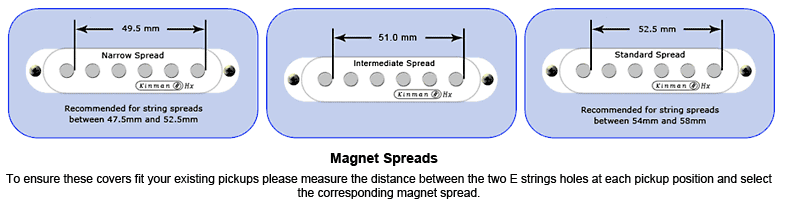
Dimensions: As of mid Nov 2000 I am supplying a new pickup cover with my Strat pickups. It can be ordered with or without a logo and is made of a special plastic that can be stained with Tea or Coffee for that aged look. Follow the link to a full description.These are available in two magnet spacings as illustrated below. Before ordering please determine which spacing your pickups are.
Tinting: No need to spend thousands of hours in smoke filled clubs to get that authentically aged look. Kinman's beautifully made Strat pickup cover is moulded in a special plastic that can be permanently tinted with water based dies such as Tea, Coffee, Curry, Henna hair dye etc. Some colours that can be made this way are .......
Mint (a light green tint seen on early 60's L Series Strat pickguards, made with Peppermint Tea)
Parchment (not too long in solution of instant coffee)
Aged White (similar to the New Fender colour) Same as for Cream but less time.
Cream (similar to Gibson P-90 cream covers, made with strong Instant coffee plus a bit of Red food dye)
Old Strat (a mixture of Mint and Cream)
You simply soak the White covers in the above (boiling hot) food solutions for two minutes or less. If stronger colour is desired then add more coffee/tea. If you make a mistake then reverse the process by soaking the cover in Laundry bleach and start over. You can order your pickups with covers pretinted from my factory for a small additional fee.Do not attempt this with the old covers as they will simply melt. The old covers can be identified by the notch taken out of the bottom of the cover, in other words the bottom of it is split into two planes. Covers are standard with Kinman logo printed in Burgandy ink. Covers are also available without Kinman logo by special request (same price). Logos sometimes wear off the covers and will leave a white mark if the covers are tinted. Tinted covers ordered without Logo will have a watermark logo, click here for details.The new covers also do not have sharp edges at the top (but it's not rounded over noticeably either), covers the lower coil completely and is more flexible than the previous cover. These new covers conform to early Fender specs in every way so it's no longer necessary to fit old covers to my Strat pickups for that authentic old look.
UPDATED 2-Sept-04. Click on " How to remove covers " to see a Adobe PDF file pictorial sequence. Begin by inserting 2 mounting screws into the screw holes from the opposite side to normal ie from the back. Just screw them into the baseplate so the ends protrude a tiny distance out the other side of the baseplate. Then gently and slowly wriggle the cover straight off the pickup keeping the cover parallel to the pickup, or damage may result. The two half-round ends of the metal shields should press lightly onto the inside of the replacement cover to prevent microphonic whistle. With the advent of my NEW Covers it is no longer necessary to use other Brands of covers because my new ones can be aged artifically (follow this link for more info pickup cover ), and can even be ordered already aged. BEWARE of non-Fender covers as these are often smaller than original Fenders. Tokai and other Japanese covers for example are a very tight fit onto a Kinman bobbin and may destroy the upper coil upon removal. Return to us for repair if damage results.
I currently favor the 'OAK' brand that's made in USA. CRL quality and price has caused disappointment in recent times. Ernie Ball has been packaging CRL switches as accessories but to be sure look for the distinctive diamond shaped CRL logo stamped onto the side of the switch and avoid it. OAK switches can also be ordered by name from Allparts and WD Music Products (see Links page) along with many other useful guitar parts and materials.
Pot values:
Ever heard the old guitarist proverb..."if it ain't got it in the first place you can't boost it later"?
General stuff:
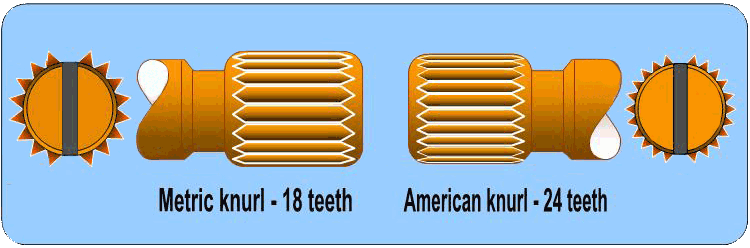
Shafts: Pots used in most guitar have a serrated shaft called a Knurl that grips the inside of 'push on' knobs. American pots have a fine 24 tooth Knurl while metric pots (Japanese etc) use a coarse 18 tooth Knurl with a slight smaller diameter, as shown in this photo.
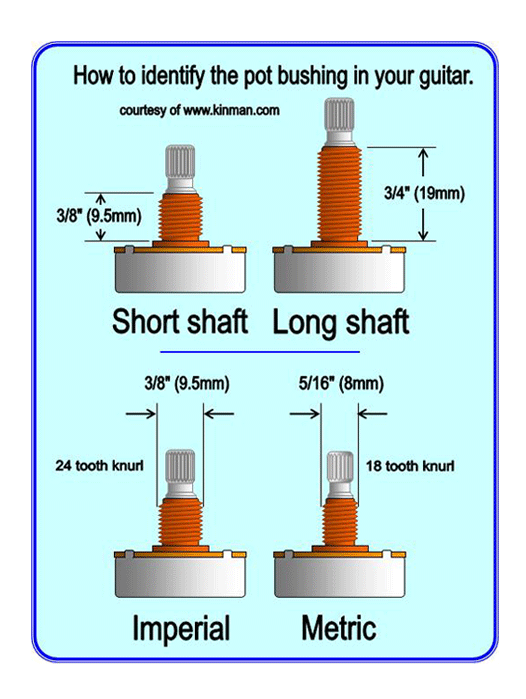
Kinman Harness use American knurls and knobs.
Metric knobs will often break when pushed onto an American shaft. Bear this in mind when buying replacement knobs or pots. If a knob is loose the split shaft can be opened up a tiny bit so the knob grips better, however be very careful and open the split only a tiny amount because some shafts are made of brittle Aluminium and will break easily.
NOTE: Telecaster, Jaguar, Mustang and P and J Bass pots use a plain shaft and the knob is secured by a grub screw.
Taper (or curve): 98% of guitars use 'A' curve pots (also known as Audio taper or Logarithmic taper) which means they behave in a manner when rotated so the human ear detects a corresponding and gradual change in loudness or tone. Log or ‘A’ taper pots are great for finger swells and feel ‘right’ when rolling back the volume. However there is an emerging trend towards Linear taper by those who use high gain and want less sensitivity when rolling back the volume to clean up the sound. There is the disadvantage of making finger swells (violinning) feel uncomfortable and somewhat unresponsive though because the pot must be rotated a lot further to achieve the same reduction with a log taper. There is no difference in sonic character between both types at any setting, only the feel.
Volume pots:
Higher value pots and capacitors cause the pickups to resonate at a higher frequency and develop more output and presence with the result that the sound is noticeably brighter. Lower value pots and capacitors have the opposite effect and push the sound towards the duller end of the spectrum with lower output. Knowing this is helpful if you want to experiment with pot and capacitor values to change your sound.The value of the Volume pot is crucial to pickup performance. A lot of pots, although labelled as 250K, actually measure much less (Eg 217K, and recently I measured 3 new Fender CTS pots at 117K) but very ocasionally they measure more (Eg 265K). Players should understand that a great pickup can be muffled by a pot that measures low, causing a dull, less responsive sound. The first thing that suffers is the AIR and Presence of a pickup. Since these are two of the most important performance aspects of Fender pickup sound it's actually a minor tragedy when these are sacrificed.
NEWS! My new NoSoldering Harness for Strats (prewired harness) comes with specially made pots that I guarantee to have a minimum value of 250K and make Kinman pickups sound at their best. Click on the above link to the Strats products page for more detailed information.
Every guitar player should have and learn to use a multimeter, they are so inexpensive these days. They are invaluable for checking leads, pots, speakers, pickups and a host of other items but I recommend restraint from messing around with mains voltage because those can KILL you. I urge you to check your volume pot with a multimeter and if it measures noticeably less than 250K chuck it out and replace it with one that measures 235K or more. ( NOTE: Pots can be measured in-circuit but have to have either the switch or the ground connection disconnected). My pickups are designed to work into traditional Strat 250K volume and tone pots. Several pickup makers recommend using higher values such as 500K or even 1Meg to reduce the choked, strangled, compressed and constricted feel in an attempt to bring their pickups to life. They try to increase the presence, output and dynamic range because their pickups lack these crucial elements of Fender tone. As many players have discovered, it's impossible to resurrect a pickup that was born dead in this manner as the extra brightness is artificial and the sound is shrill and empty with no real air and no real dynamic range. However I encourage you to experiment and find what it is you like but don't be surprised if you find that my pickups respond favourably working into 500K pots. If it's built right in the first place it has a degree of flexiblity in choice of Pot loads.
Problems with high value Volume pots:
when you turn the volume control down a lot of hum/noise is introduced. This is because the amplifier input is becoming progressively unloaded and is effectively floating (like when the cable is not connected to your guitar) which results in hum/noise. 250K pots also exhibit this characteristic but not nearly to the same extent as 500K or 1Meg pots do. The higher the value the worse the problem becomes, it's part and parcel of high impedance circuitry. Also be aware that 1Meg ohm pots (and to a lesser degree 500K) have an unpleasant ramp-up characteristic that a lot of high-gain players won't like. When turning up from zero, instead of a smooth transition back to full volume there is an unpleasant turn-on transient or 'crack' as it comes off zero. The 1Meg pot (and to a lesser degree the 500K) just can't deliver a smooth ramp up, only a 250K pot can deliver the performance that many guitar players expect when violining or swelling from Zero.
Tone pots
These also have a small effect on tone even while turned fully up to 10. Once again, to achieve aged tone my pickups are designed to operate into a 250K pot with the standard .022 capacitor. Increasing the value to 500K or 1Meg will certainly result in more presence/brightness if that is desired.
No Load pots
Fender use these as a tone pot on their Delta tone system and some other modern Strats to very slightly increase brightness. No-load means when the pot is set to 10 there is no connection of the capacator via the pot; that is to say there is no capacator load on the pickup via this pot when set to 10. With the pot set to 9 the capacitor is connected and brightness and ice-pick edge will begin to soften.
Tone control capacitors: The value of the tone capacitor will determine how much attack/brightness/presence will be cut by the tone pot. The higher the value, the less bright or more dull the tone will be when the tone control is turned down. The tone capacitor on early Strats was 0.1mF, this was changed to .047mF in the 1970's and later changed again to .022mF. The voltage rating is not important, however 63 volt caps haves thicker wires that are easier to work with. The common Polyester cap (aka Greencap or Mylar or Epoxy) works well but some Tone Connoisseurs prefer the old original Waxed paper type even though the difference is so small in 'passive circuits' as be insignificant. It should also be understood that the capacitor has an effect even when the pot is set at maximum (10). This is because the 250K resisitance of a pot allows some signal to pass through the cap to ground thus sucking a small amount of the highs. A 500K pot allows less effect when set to maximum, and a 1 Meg or No Load almost no effect at all. Changes in tone might be heard when the cap values are changed, even when the pot is set at maximum (10). Remember the lower the value of cap the brighter the tone, even with the Tone control is set to 10.
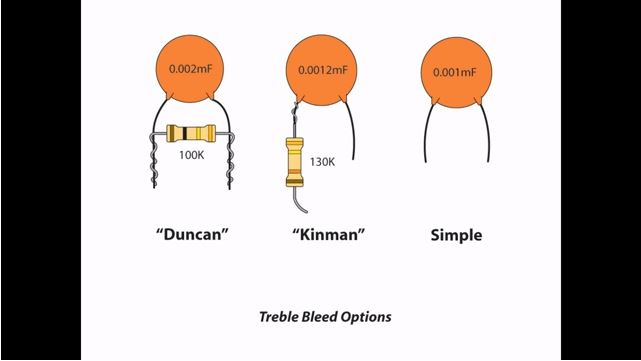
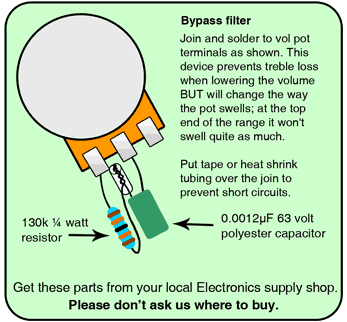
VOLUME Control control: (Treble Bypas fikter -or- bleed filter)
Click to watch the Youtube video
I get asked a lot about how to stop losing treble/presence when the volume is turned down. Kinman Hx pickups don't suffer from this phenomena to the same degree as regular single coils, in fact many Kinman owners tell me they noticed the problem disappear when they fitted their Kinman's. This device, when used with Kinman Zero-Hum pickups, might actually increase the brightness slightly as the volume pot is wound down, making it great for volume reduced rhythm chops. When used with regular non-noiseless single coils it attempts to preserve the amount of brightness as the volume pot is wound down. But if you have this problem and want to reduce it I devised a little circuit that helps. It is simply a .0012uF (1.2nF) 63* volt Polyester capacitor in series with a 130K Ohm resistor (1/4 or 1/2 watt) that is wired across the two hot terminals of the volume pot (*the voltage rating does not impact the performance of this device, any voltage cap will work fine but 63 to 100 volt caps have lead wires that are easy to work with). A rudimentary way of looking at it is the cap allows some of the high frequencies to pass around the volume pot direct to the output and the resistor limits the amount of them that get past. The capacitance can be varied slightly from .001 to .0016 to fine tune the circuit to your cable, but you will have to increase the resistor value with the larger cap values and decrease the resistor value with the smaller cap values or else you will notice the curve of the pot starts to become noticeably different with the larger cap values. It's a delicate balance so deviating from the nominated values may excessively flatten the operating curve of the pot unless you compensate with the resistor value. Read more technical guff about this on the FAQ page Q24 . Rule of thumb is the *amount* of brightness that is gained is determined by the resistor's value (less Ohms = more brights) but the frequencies that are present is determined by the Cap value (lower the value the higher the frequencies, the higher the value the lower the frequencies).
By the way, this design works better than a 'capacitor' only -or- the parallel 'resistor/capacitor' design that some makers fit to their guitars, so if you didn't like theirs try this one. These circuits, including mine, are quite crude and won't suit all conditions. They leave very little latitude in deviating from the nominated cap value. You will have to experiment to arrive at the perfect value for your cable. To save time in experimenting you can run some wires out from the volume pot under the edge of the pickguard then you can connect various value caps and resistors to the ends of those wires in a matter of seconds. When you get the right combination they can be soldered to the pot terminals.
NOTES:
It is not necessary to use it on active circuits such as Eric Clapton Strats where the volume pot is 50K or 25K.
Will it also work with the 500K pot? In general YES, but a certain amount of experimentation might be required with this because it's not particularly related to the pot value although that might affect it to a degree. It's more about balancing the capacitance of your cable, so obviously there are many varied operating conditions that I can not possible know about. The cap value of .0012 balances my cable which is typical of many but it won't suit all. The cap value should ideally be varied according to the cable in use. Change your cable and possibly that means changing the cap. The resistor determines the intensity to which the cap does it's job and helps preserve the pot curve. Without the resistor the pot curve turns almost linear.... i.e. it looses it's taper and 'swell' effect as it approaches maximum volume. NOTE: The drawing below shows only the relevant components, there are other wires connected to the pot but they have not been shown.
Phase (or output polarity) test method when contemplating mixing different brands or types of pickups.
What is Output Polarity?
Phase (aka output polarity) is only important when pickups are switched on together. To sound in-phase when switched on together pickups must have the same phase (or output polarity, not the same as magnetic polarity and/or coil polarity). There is a 50:50 chance that out-of-phase sound will be the result when mixing different kinds or different brands of pickups.
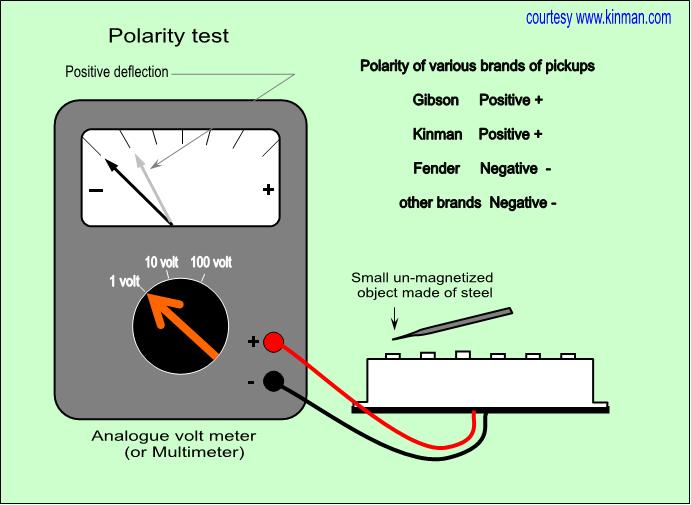
Follow this link to learn how to determine and compare Phase or Output polarity of different pickups before you do the install. If different, one pickup must be reversed, either with magnetic polarity or connection polarity to bring the output in-phase.
Mixing Single coils with a Humbucker: This is problematic because there are two fundamental problem when mixing single coils and humbuckers. One is there is a huge loudness difference between the different types of pickups, that's the reason we invented the Big-Nine-O Strat pickup. Another is because they require different value Volume pots for optimum performance. Several of our Goodbye Soldering Harness can be ordered with our proprietary Auto Dual 250k/500k volume pot loading.
FORENOTE: There are two different types of noise, hum and buzz. Hum can be cancelled within the pickup but buzz can only be prevented from entering wiring with shielding.
Every electric guitar needs shielding to keep unwanted electrical noise from getting into the wiring and controls. But be aware that many players choose not to install shielding because most unwanted noise is kept at bay by virtue of the fact that they themselves act as a shield when in contact with the (grounded) strings. Letting go of the strings removes the shielding effect and noise will enter the wiring, BUT this doesn't happen often because most players turn the volume control down to prevent handling noise or risk having the strings break into feedback so noise is not a problem. If you are one of the majority of players who practice this then you may not benefit much from shielding. But if in your style of playing you cease to have contact with the strings or bridge while the strings are sounding then shielding may be a benefit.There are basically two types of shielding available. Adhesive backed copper or aluminum foil and conductive paint.
The most basic shielding that is absolutely necessary is (a) the strings being connected to ground (the grounded strings act as a basic shield for the pickups) and (b) a piece of metal foil applied to the underside of the pickguard (or floor of control cavity in rear rout guitars) in the control cluster area. This does not shield the exposed wiring of other parts of the guitar such as the jack socket and connecting wires.
First let's discover if your guitar has effective shielding: You can tell how good the shielding is by observing the increase in buzzing when you are not in contact with the strings or any grounded hardware and when you are in contact. You must be wearing the guitar in a normal playing posture to conduct this test. If the change is not significant it means the shielding is doing it's job quite well. Most all American Strats made before late 90's have very ineffective shielding but Fender improved it in subsequent years.
All Kinman pickups for Strats and Teles have included a shielded output cable to provide maximum immunity to noise (buzzing, as distinct from hum). However if the guitar is comprehensively shielded there is little improvement to be had by using the cable. Trouble is most guitars (Strats & Teles) are not shielded that well, and do not have shielding in the tunnel that the output cable goes through anyway.
For newer guitars.
If you don't feel confident in this method go to the next section on Shielding for Vintage. I like conductive paint for newer guitars but there is often a problem in getting it to adhere to painted surfaces. I get round this by scraping the paint of the cavity surfaces by using a router with a dulled �" bit (12mm). Since it's not sharp it will only remove a very thin layer of wood. The exposed wood is an excellent surface for the conductive paint to stick to. Test the paint on a painted section of cavity floor to see if it sticks satisfactorily before getting into this too deeply.
I also undercut the wall of the output socket cavity to prevent shorting of the socket terminals to the conductive coating, like in this drawing . Using a special T cutter, that has the corners rounded or chamfered off, undercut (by 2mm) the output socket cavity by letting the shaft of the cutter rub on the cavity wall. Provide just enough clearance for the terminals so it's not necessary to rout full cavity depth and it's only necessary to rout part way round the wall (from where the terminals poke out to the tip end and back, like shown. Then I link both the main control cavity and output socket cavity together by coating the drilled connecting tunnel with conductive paint (using a shaggy artists brush). After the paint has dried thoroughly test for continuity between the cavities with a multi-meter set to Resistance x 100. You should have no more than about 2,000 ohms between the output socket cavity and the neck pickup socket for an effective shielding job and with really good paint you will get as little as 3 ohms. If you don't achieve this then re-coat anywhere that looks thin or streaky. You can purchase conductive paint from Allparts or Stewart McDonald, see links page. WARNING: Conductive paint contains solvents that will dissolve lacquer finishes of older guitars. I always test for this on a covered portion of the painted surface with a little denatured alcohol (100%) on the tip of a finger. If the finish goes sticky then it's lacquer so be careful not to spill or drop any paint onto the guitar. If you do drop some paint onto the guitar wipe it immediately with your finger or a cloth. The smeared surface can be fixed later by cutting and polishing. Leaving it there to dry will result in an unsightly swelling of the finish that you may never remove.
Spilled paint on a modern polyester finish can be removed with solvent without any harm. Just don't rub too hard as it will scratch the finish.
For Guitars with vintage value there is only one choice and that's adhesive backed Copper foil (available from Allparts Part #EP 4991 Copper Shielding Tape 12" x 12" - see links page). This does not change the guitar in any permanent way and therefore the guitar will retain it's originality should the foil be removed. Aluminum foil is not suitable since it is very difficult to solder. First clean the surfaces to be stuck to with a clean cloth damp with solvent such as White Spirit, Mineral turps or other non-agressive type solvent that won't harm nitro-celluose finishes. Then cut the foil to fit neatly onto the floor of the various cavities and stick in place. Next cut some foil into strips .6" (15mm) wide for the sides of the cavities, shielding full depth offers no advantage. Next; solder the floor piece and side pieces together with a blob at intervals of 1 or 2 " (25 - 50mm), just enough to stop it coming adrift should the adhesive backing fail. To prevent accidental shorting of the output socket terminals to the shielding cover the wall of the cavity with some kind of sticky tape. Ordinary household tape will do. Same applies to the wall adjacent to the selector switch terminals. Connect the output socket cavity shielding and main control cavity shielding with a tube of copper foil fashioned by forming it around a drinking straw (or similar object). Insert this tube into the drilled connecting tunnel. Splay the ends out and solder each end to the two cavity shieldings. Ground the completed shielding with a wire soldered to the copper and connected to the back of the volume pot (central ground point). Most pickguards require shielding only as a cap over the main control cavity (see strange noises below). This can be of adhesive backed Aluminum foil as it doesn't have to be soldered. It is grounded by virtue of pressure contact with the controls. When completed check for continuity with a multimeter between all the various sections of copper foil fitted to the body cavities. You will get a ZERO ohms reading if all is in order.
Once in a while I receive mail from distressed players saying they have a scratchy noise when their fingers rub on the pickguard. This is static electricity and can be cured by applying Aluminum or Copper foil to the entire rear of the pickguard but allowing a 1/4" (6mm) border around the pickups. The foil should be adhesive backed and stuck to the pickguard. It should also be grounded by contact with the volume pot so be sure to remove any surface coatings (clear lacquer) that Aluminum foil often has to protect it from oxidation.
A quick fix is to spray 'Static Guard' onto the pickguard. Static Guard is intended for soft goods like clothing and carpets and is available in spray cans from some Hardware stores, Pharmacys and supermarkets.
There are a few secrets to keeping your Strat with a traditional bridge (and twin pivot bridges) in tune and I'm going to pass these along to you here (some aspects also apply to Telecasters). Many players blame the bridge for failure to return to pitch when actually it's more likely to be the fingerboard nut to blame. When you bend notes or use the Vibrato bridge the strings must be able to slide freely through the 6 little grooves in the nut. If there is any friction in those grooves then there is a strong likelihood they won't return to the correct pitch when you have finished the bend or Vibrato. Same applies to the String guide (or string tree). The properties of the material itself is the primary cause but tight grooves can also contribute to the problem. Also, the modern roller and ball bearing nuts are just as troublesome as the old plastic (bone) ones. The rollers or balls seize and stop rolling causing string drag.
To prove the point with conventional nuts melt a little bit of candle wax into the grooves with the strings pulled to one side. For a good job use a soldering iron (not very hot) to make sure it has penetrated into the grooves thoroughly. Re-tune your guitar and try bending or Vibratos again. If the pitch return is better then you have the answer. Unfortunately candle wax is only a temporary solution.For a permanent fix Graphtech make nuts and string guides that work quite well but are quite soft and will not last such a long time. Remember that the nut grooves will be optimized for a specific string gauge so if you decide later to go to a heavier gauge then the grooves may have to be widened. Also keep in mind that excessive angle of strings as they pass over the nut causes inherent friction so keep the angle to a minimum and align the bottom of the groove with the string tree or termination point on the tuner shaft.
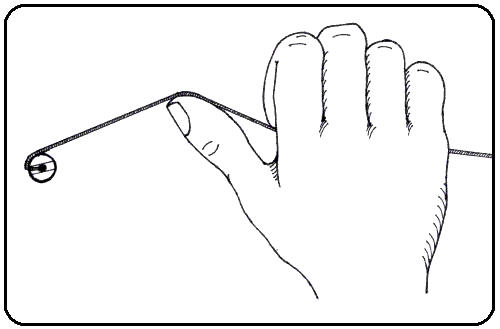
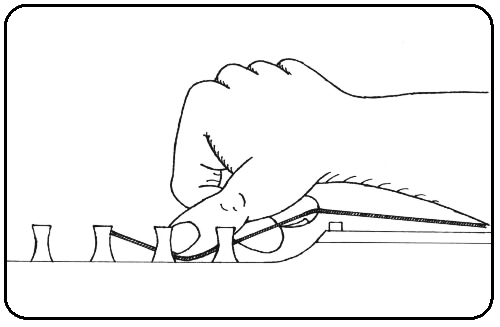
Next is the way the strings are terminated around the tuner shafts. Basically you need to keep the turns around the shafts to a minimum. In 1984 I developed a way of limiting this to half a turn and with no slippage, provided you have the split shaft tuners such as Klusons or Gotoh (my favorites because the split in the shaft allows you to lock the string on with an absolute minimum of turns). Many players believe that wrapping all of the excess string around the tuner shafts will prevent slippage but actually the reverse is true. All those overlapping turns provide a lot of scope for slippage and sudden re-seating. Same goes for tying strings onto the tuner shaft. First step, cut the E & A strings 25mm (1") past the corresponding shaft and poke the end into the hole at the bottom of the split. Then, after bending the string sharply out of the slot and with the string pulled tight with your fingers (see diag 3 and 4 below), wind the string around the shaft and up to pitch. Second step, cut the D, G, B & E strings cut 40mm (1 -5/8") past the respective shafts (shown in diagram 1 below). Poke the end into the hole and wind tightly around the shaft for 1/2 turn, then lead it back through the slot again (for a second time) and continue winding up to pitch. Take care to ensure that on the second pass through the slot that the string exits the slot underneath the first loop of string, not on top of it (see diag 2 below). This helps to maintain more break angle over the nut by providing a steeper exit angle behind the nut.
Diag 1.
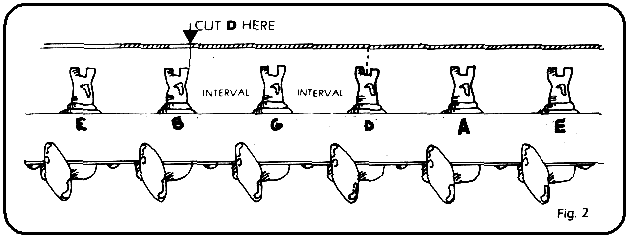
Diag 2.
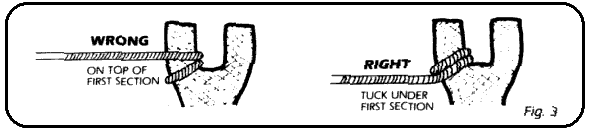
Diag 3. Keep the string taut during terminating and winding the string.
Diag 4.Keep the string taut AND angled down while winding.
If your guitar is fitted with Gotoh heads you will now have about 1/2 turn of string around the shaft at concert pitch. If you have Klusons you will have about 1 complete turn. Either is satisfactory for the purpose. Don't be alarmed, this is a tried and tested method and I have recommended it with great success on my Blueprint series guitars since 1984. Lastly the bridge itself. As long as it pivots freely on the 6 mounting screws without any binding or friction then it is best adjusted so that it floats off the body by about 3mm (1/8") at the rear of the bridge plate. This is the ideal position to allow Vibrato and facilitate returning to pitch since it reduces saddle-top friction by lessening the string break angle over the saddle. A floating bridge will return the strings to pitch better than if it is flat on the body. If it binds on the screws then obviously there is a problem that needs to be remedied by a good quality guitar repairer (see Links page) who should be aware of the next section dealing with bridge installation. Finally a few words about managing the system. Tune up to pitch string by string. Stretch new strings a little bit by gently pulling them sideways at mid point along their length. Repeat tuning until all strings are stabilized. (Stretching is important each time you restring as new unstretched strings have different intonation settings) Push the vibrato arm down almost to the body and let return. Check the tuning again and if any strings are sharp simple detune to pitch, do not go below pitch and then tune back up (this defeats the purpose) If any strings are flat then tune up to pitch, do not over shoot the mark. If you accidentally do overshoot and find the pitch is too high start the process over. It's important to sneak the string directly to pitch from either the sharp or flat positions. Overshooting is a No No. Now you'll see why I like Gotoh tuners. Having accomplished that step press the vibrato arm again as before and repeat the string tuning process. This may have to be done up to 3 times. If it takes more than 4 times to stabilize then there is something wrong in the system, perhaps a tight nut groove. When it's stabilized you should be able to deck the arm and have the strings return to pitch satisfactorily.Now when bending strings, particularly the plain G, they will return flat, but don't panic. Simple press the vibrato arm again, as you did before, and presto the G will pop back into tune as if by magic. So you have to remember that when bending the G (and to a lesser extent the B & E) it will always return flat so just remember to press the arm and continue playing. The severity of the push is dependent on the severity of the bend. This method works on practically all Strats irrespective of whether Traditional bridge or a modern Twin Pivot bridge is fitted.
In my humble opinion the very best Strat bridge is the original Traditional Vintage Strat bridge that Leo himself designed. The one with 6 mounting screws at the leading edge of the bridge plate. These are so important in achieving a real Strat sound. If your Traditional bridge is set up correctly it will return to pitch just as well as the twin pivot bridges that are fitted to many modern Strats (see "Keeping it in tune" section above). Fenders twin-pivot bridge such as fitted to their American Standard and American Deluxe series has a couple of design features that you should be aware of. The string spacing is a bit too narrow for regular Strat pickups (neck position pickup is worst affected) AND it has a slightly mushy tone (less crisp attack, less twang, less definition).
NEWS update-1: As of February '01 Kinman sets are being shipped with a special neck pickup (as standard) that aligns perfectly with both types of Strat bridges. It's known as the narrow spaced type. At the extremes the magnets are 3mm closer together.
NEWS update-2: Sometime prior to November 2004 it appears Fender made significant improvements their twin pivot bridge with respect to sonic performance but the saddle/string spread remains unchanged.
The difference between these bridges is often as dramatic as night and day. It depends on some other unpredictable factors about your guitars construction. If you are interested to know more then read the next section " A simple experiment ....". Floyd Rose (Genuine) bridges have a suitable string spacing for regular Strat pickups and don't sound too bad. While these are not my favorite bridges at least they are an acceptable alternative to the Traditional type. The examples I have seen have a radius setting that suits my staggered pole configuration. If you really want to get traditional Strat sound and performance I recommend that Fenders twin pivot bridges be replaced with a Traditional Vintage type. At my suggestion Callaham now makes a simple but very clever kit that utilizes the original pivot post inserts to mount the 2 outermost screws of a Vintage bridge (see below). The American Standard, Strat Plus, American Deluxe are a few of the models fitted with a twin pivot bridge. I am a perfectionist so remember these are my personal comments. Many players have been thrilled and delighted with my pickups when they fitted them to their American Standards and other Strat models with Fenders twin pivot bridge. It's just my personal view that ANY Strat with a Traditional Vintage bridge is more desirable than one with a twin pivot bridge. But also beware of some "Made in Mexico, Taiwan and China Strats" as some of these have a bridge that look similar to the Traditional type but actually have a very narrow string spacing that will not be compatible with most all brands of Strat pickups. (The poles will mis-align with the strings and you won't be able to upgrade the pickups to most popular brand, but Kinman's are OK because of the narrow spaced neck pickup). The traditional width between the two E strings on the bridge saddles is 56mm or 2.2 inches and the narrow bridges it's more like 52 or 53mm.
A simple experiment to partially gauge the negative effect your Twin Pivot bridge has. Take the back plate off to gain access to the springs and rear of the bridge block. Notice how the bridge floats and can be pulled up or pushed down (with respect to the body). This can happen because the block attached to the back of the bridge has clearance on both sides of it, allowing movement in both directions. The object of this exercise is to disable that movement and lock the bridge to the body. The simplest way to do this is to fit a little piece of wood or something similar between the leading side of the block and the side of the cavity in the guitar's body. This piece of wood should fit snugly in the existing space, and maybe even push the block away from the wood a tiny fraction. Once in place tighten the spring claw screws to increase the spring tension thus increasing the clamping force exerted onto the piece of wood. Position a little dollop of BlueTak (sticky plasticine kind of substance) onto the 'wood' and 'block' to prevent the piece of wood falling out when you press the Trem arm down. You should now notice that it takes quite a lot more exertion to press the Trem arm down. After re-tuning, you should also hear a difference in the sound, an improved difference. The result, although better than previous, is still not as good as a Traditional Vintage type of bridge (the one with 6 mounting screws at it's leading edge). Hopefully this little experiment will influence your decision next time you purchase a guitar. But it is possible to retro-fit a Traditional bridge without any modification to your Strat. This modification allows reinstatement of the original bridge at any time. Read the next section.
You can use a genuine Fender bridge but I highly recommend Callaham bridges as THE BEST. You can use a Gotoh which may or may not be cheaper and more available (depending on what country you live in), these are quite good. Gotoh make two vintage models, one has a die cast block; the best one has steel. The steel block sounds better and the arm socket thread won't strip out nearly so easy as the die cast one does. The model No. for the steel one is GE-101TS C or G (Chrome or Gold). It has American screw threads that are interchangeable with Fender USA bridges and the fixing screw spacing (56mm or 2.2") is accurate to the genuine old Strat bridges. In my opinion the best alternative is the Callaham (USA) vintage Repro bridge. Follow the link to Callaham on my Links page. These have an awesome reputation and many of my more discerning customers swear by these. Fender make a special vintage bridge with mounting screw holes that are closer together. These won't fit old guitars but are handy for the present purpose if the fret-end angle is too sharp. The sharp angle reduces the length of the fret and the strings need to be spaced closer together (see diagram below). Of course a refret will solve this provided the guitar repairman is of a high standard (beware of butchers and pretenders). You will now have a proper Strat with a classic Strat sound. Have fun and enjoy the NEW sound of your transformed guitar.
One thing that can impact on choice of bridges is the way the ends of the frets have been finished. Fret ends that have been filed with excessive angles means the strings coming off a wider vintage bridge will be perilously close the end of the working surface and become prone to falling off onto the ramp surface. This is especially true for high frets such as Jumbo or Gibson sized fret material. The illustration below clearly shows the reason it's important to pay attention to this aspect of refretting.

Strings - my thoughts and experiences.
Steel: (regular strings) are great because they are bright and loud because they are highly magnetic, but must be kept clean to last.
Nickel: Not as loud or as bright, in fact a bit on the dull side being not as magnetic as regular steel. This causes the plain strings to be louder and brighter then the wound strings. Last longer because they don't have the brightness to begin with so no noticeable difference is perceived as they age.
Round wound versus Oval or Half round wound: Any sort of surface grinding dulls the sound. Half rounds are extremely dull, almost thuddy not too different to flatwound Jazz strings. Even GHS 'GUS series' oval wounds are dull by comparison to regular round wounds. The problem with these types of strings is the plain strings are louder and brighter than the wound strings.
The bigger the better?: Personally I like D'Addario .010 - .052 Round wounds, but really it's a personal preference thing. However I recently tried .010 ~ .046 and found the 46 produces better growl. I do think some players could benefit from a little more knowledge, experience and experimentation. Remember that the Set-up of your guitar begins with string selection. If you change string brand or gauge a minor Set-up adjustment will likely be required to ensure the best play-ability.
Tension: Some high tension strings (Jim Dunlop) are appearing on the market, not only do these feel tight but reflect a tight sound (reduced expression) from reduced dynamic range. Some others (DR) have low tension and these produce more fret crash and buzz unless the saddles are raised.
Longevity: Grime and foreign material from fingers chokes the windings resulting in dulling off of sound. Cleaning after every session is of paramount importance. I advocate wiping the strings with a Blitz cloth on both sides at the finish of every playing session, meaning on the underside as well as the top side. This can be accomplished by inserting the Blitz cloth between the underside of the strings and the fretboard and dragging the cloth up and down the length of the strings several times, as well as on the top side. This cleans away any substance that can give rise to the corrosion that rusts strings. Simply cleaning the upper surface is not good enough because strings can be rusting away on the hidden side without you realizing it. Rusty surfaces are highly abrasive and wears frets extremely fast and causes severe intonation problems. Keeping your strings clean and rust free extends the life of frets dramatically and allows the strings to intonate for maximum enjoyability of your instrument.
Return to top.
Magnet/String alignment improved
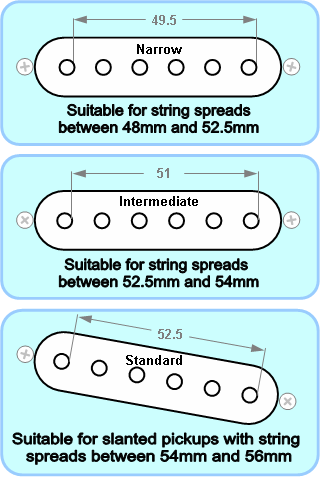
For your information Kinman Strat pickups are available with a choice of 3 different magnet spreads that provides optimum alignment of the magnets to the strings. Doing this ensures the best balance of string volumes without drop-off, especially during stretching the strings sisdeways accross the fretboard. All other brands have just one magnet spread and we think that is inadequate and quite un-satisfactory since at least one of the E strings over the neck pickup will often align outside the outer edge of respective magnets and consequently will not be as loud as the other strings. Eg American Standards have this problem.
After payment of your order is received we send you an email with a link. Click the link and you will be presented with three options for choosing your magnet spreads.
First a few points:
1. 52.5mm is Standard and is the widest magnet spread of any Strat pickup ever made for 6 strings.
2. Kinman also makes 51mm Intermediate and 49.5mm Narrow magnet spreads.
3. We consider it satisfactory when the strings align within the perimeter of the magnet�s top surface. It is OK for the strings not to align with
the dead center of the perimeter, in fact it is preferable for the strings to lie over the outer half so when stretched sideways they remain
more within the perimeter.
And now the three options:-
> Magnet spreads: Bridge 52.5mm / Middle 52.5 / Neck 52.5
> Magnet spreads: Bridge 52.5 / Middle 52.5mm / Neck 51mm
> Magnet spreads: Bridge 51 / Middle 49.5 / Neck 49.5
Additional Information:
All Fender non-noiseless (the N3 is noiseless) and practically all replacement Strat pickups from Duncan, DiMarzio, Lollar, Fralin etc have Standard 52.5mm and unacceptable string/magnet alignment of the neck pickup when used in conjunction with narrow bridges from Fender, Wilkinson and Floyd Rose. Kinman is the only brand of pickups to have this much needed refinement.
String/magnet alignment is not associated with fretboard radius as some mistakenly believe. To understand string/magnet alignment you must be aware that the strings are not parallel but are wide apart at the bridge and closer together at the nut. This taper causes the primary alignment issues and can be compounded by saddle mis-alignment too.
Misalignment is most often caused by narrow bridges but the reason for excessively poor string/magnet alignment could be the saddles or it could be pickguard mis-positioning or neck/body mis-alignment.
Unfortunately saddles often drift to one side when they are not set horizontally. Make sure the grub screws are adjusted so the saddles sit horizontally. It is also legitimate to adjust the saddles with a deliberate lean to force the string in a more desirable alignment.
*Stratocaster and *Strat are trade marks of Fender Musical Instrument Corp. Kinman Guitar Electrix is not associated with Fender but they kindly consent to me referring to their marks. Fender have asked me to tell you that they do not endorse Kinman products (understandably :)
NOTE: This info is copyright and must not be used for commercial purposes by any other party. Chris Kinman (c) 1998.
We lead in No-Hum pickup technology today ... others will try to catch up tomorrow. Who are you going to follow? the innovator or the imitator?
The following information is not intended to alleviate the need for you to become friends with a high quality guitar repairman and have him perform his magic on your guitar occasionally. All guitar players can benefit from consulting a high quality and knowledgeable repairer so don't skimp, it can be money well spent. Beware of pretenders though, repairers in the quality catagory are relatively hard to find. Check your prospective out thoroughly. The last thing you want is for some Axe murderer messing with your trusty guitar.
Now, how to adjust your Kinman pickups to get the sounds you've always wanted, and more....
Be aware that your cable can make or break your sound. To get the best from your Kinman pickups you need a low capacitance cable. The Klotz vintage 59 is the best one but some others work pretty well too. See the list, navigate to Blogs > Any old cable won't do
Pickup adjustment
Neck adjustment
String height adjustment
Intonation adjustment
String choice
Before I get into this I want you to understand that the value of the volume pot is crutial for performance. Please check it as described on the Perfect Guitar page > Pot values . The following may be a waste of time if the volume pot value is not right.

The two best tone controls you could wish for, nasty to sweet in 2 turns (and much more in 3 turns).

Before you begin it's a good idea to start with a clean slate. Don't try to adjust your new Kinman pickups using your previous amp Eq settings. I suggest you set the tone controls to 12 o'clock (position 5 on the knobs) and dial the adjustments in from there, adjusting the Eq controls only after you get the best result from the pickups. The amp controls will then just fine tune the basic correct pickup adjustments. Don't be afraid to use the controls, that's what they are there for. If your sound needs more brightness simply turn the treble control up.
You can explore from a low pickup height setting with a high volume amp setting OR with the pickups at maximum height with lower volume amp settings. Some players prefer one or the other and some prefer inbetween so PLEASE experiment and try both approaches.
Beginning with Maximum height:
Set the gap at the neck pickup (both E strings only) to 2mm or 5/64", but not less than that.
Set the gap at the middle pickup (both E strings only) to 2mm or 5/64", but not less than 1.75mm or 1/16"+.
Set the gap at the bridge pickup (both E strings only) to 1.5mm or 1/16", but not less than that.
To get a workable volume balance between the neck and bridge pickups I suggest you adjust the bridge pickup to your desired sound. Then adjust the neck pickup so it balances. Occasionally we have to put up with a little bit of imbalance to get the sound we want from each pickup, this is normal.
Beginning with Minimum height:
Set the pickups almost level with the pickguard and raise a little at a time until you discover where your sweet spot is. Take care not to let the pickup drop off the end of the screw. If this happens the only way to get the screw started again is to take the pickguard off.
Tilting the pickup: Adjusting the pickup closer to the plain strings will accent the treble in the sound. Adjusting the pickup closer to the wound strings will accent the bass in the sound.
NOTE: If you use less than the recommended gap measurement the sound will be abrasive and harsh and we wouldn't want that now would we, or would we? ALSO these gap distances assume the vibe arm is depressed and not raised. If you pull up on the arm you'll need to increase the gaps accordingly or else the strings will bottom onto the magnets and cause a terrible crashing sound through your amplifier.
Increasing the gap will reduce output level and brightness, some people will like that but others won't, so experiment to get the effect you want. Remember that even 1/4 turn of the adjusting screws can make the difference. And don't be afraid to lower the pickups almost to the pickguard and turn the amp volume up.
You can do things like optimize the neck pickup for loud lead work, the middle for softer rhythm and the bridge for bright twang, bite and growl, or any other responses you would like. Another nice rhythm sound can be achieved by setting the neck pickup down more on the bass side (3mm) than the treble (2.5mm). The in-between sound (2 pickups on simultaneously) can be varied to a surprising degree. For maximum hollowness in pos 2 or 4, set the pickups as above, but for more quack/bite adjust the middle pickup away from the strings. You make the rules here, so experiment!!!
Kinman pickup adjusting screws are the two best tone controls you could wish for, and so much better than relying on the volume or tone controls to dial-in your sound.
My pickups are more responsive than any other pickup to these settings and a wide variety of tonalities can be achieved by messing around with them. Spend a little time exploring this whole new world of tone and dialing in your sounds one pickup at a time, the effort will be well worth while. And don't be discouraged if it takes some time, I've heard of players finally achieving their goals up to 2 or 3 weeks on. One customer even took his pickups out and put them in a drawyer for 3 years believing the pickups could not deliver his preferred sound. However after 3 years he re-installed them and spent a few days messing around with adjustment and to his astonishment he discovered his perfect sound that put him is tone heaven. Now he says there is no way he's taking them out again. Learn from his experience.
STRAT-ITIS explained (Strat-itis = simultaneous multiple discordant frequency syndrome).
Dirty or rusty strings can also do this but many players know this horrible phenomena is caused by excessively strong magnets in the pickups, here's how it works. What happens is the magnets of the pickups pull on a section of the string (the part that's over the pickups) into a U shaped vibration path. Normally the strings vibrate in what is essentially a single-plane path or pattern that is more or less straight (not U shaped). Lets say that the time taken for a string (not subjected to excessive magnet pull) to complete one cycle or oscillation is X milliseconds (this is the pitch of the note). Traveling in a U shaped path it actually takes longer to complete one cycle or oscillation since the distance is greater via the U shaped path, so the time is X + Y milliseconds. Now it's getting clear that what you have is a string that has a section of it's length vibrating in a U shaped path and part of the remaining section traveling in a straight single-plane path and yet other sections traveling at all frequencies between these two extremes. This means that the three sections are actually vibrating at many different frequencies when the string should be vibrating uniformly at a single frequency. What happens when you mix all these different frequencies together? Uggghhh, dissonant Strat-itis that's what! It's bad enough hearing 2 non-harmonious notes coming from a single string, but when you get multiple dissonant frequencies (or notes) being produced simultaneously from a single string the results are absolutely ghastly. A string that's out of tune with itself no less. That's what Strats do when you adjust the pickup magnets close to the strings. But when you adjust them to prevent Strat-itis, output, sensitivity and dynamic range are reduced and noise is increased when the Amp's Volume is turned up to compensate.
Fortunately Kinman Strat* and Tele*pickups utilize a unique magnet technology that reduces the string pull of Alnico-5 by around 35% and virtually eliminates the multiple note syndrome in Stratocasters. This is not magnet aging or degaussing, this is something new, something unique to Kinman.
Checking the truss rod adjustment.
1. The neck should be almost straight when the guitar is in tune. You can check this in two ways. With the guitar in a playing position (important), first eyeball along the edge of the fretboard, this will give you an indication of any massive discrepancies, such as a banana bend or a kink. Next, hold (in turn) each of the two E strings down at the 2nd fret and the 16th fret and note the gap between the string and the crown of the frets (see fig 2). A gap of about .06mm or .003" (the thickness of a piece of paper) is ideal but it can be a little more. If this measurement is excessive then adjust the truss rod until at least one side is straight (due to twists it is permissible for one side to be a little more bent). Don't over straighten either side and remember to readjust the truss rod if you change string gauges or switch between different brands, such as D'Addario and DR which have different tensions.
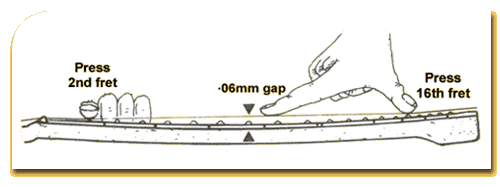
Checking the string set-up:
2. Next you have to check the string heights above the frets. Measure the gap at the 12th fret between the string and the crown of the fret with the note on the 1st fret closed. For a .009"-.046" gauge the E1st string should measure no less than 1.2mm (3/64") and the E6th no less than 2mm (5/64") but 2.1mm is better. The intermediate strings should increase gradually to bridge the two E strings. Because the bass strings have more excursion than the thinner ones their gap has to be more, to prevent unwanted rattle or clunk (that's when the string hits the fret so hard it actually discharges most of it's energy with a 'thunk' sound). This is deceiving because it continues to vibrate, but without the bass frequencies and with much less output. Don't be fooled into thinking the action is really great (low) and it doesn't rattle; it's just that it's gone through the 'threshold of rattling' into the clunk zone and you're loosing more than half of your tone and output level. Get used to having the action higher, it will only take a week and your sound will be so much better.
Set the following gaps at the 12th fret with the first fret closed. These measurements suit .009"-.046 gauge strings, for heavier gauges you can reduce the gap slightly but for lighter gauges I recommend that you increase the gaps slightly. If the string bends choke in the upper register it probably means there is an End-kink in the neck at about the 15th fret. This is a very common problem with guitar necks. The simplest way to overcome this is to raise the action height until the bends don't choke, alternatively you can have the fretboard relevelled and refretted (ouch!) by a high class guitar repairer. Don't even think about getting it done by anyone less.
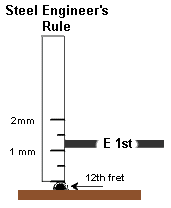
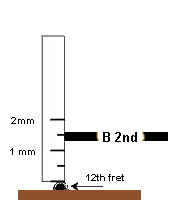
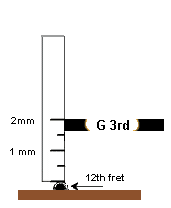
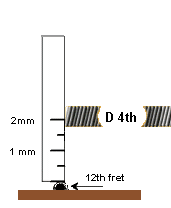
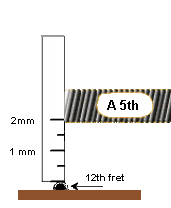
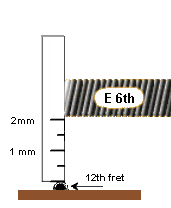
Keep the ruler at right angles to the fret over which you are setting the string gap at.
IMPORTANT: Use a jeweler's magnifier to see the graduations on the ruler in detail.
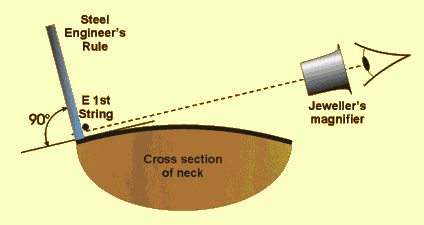
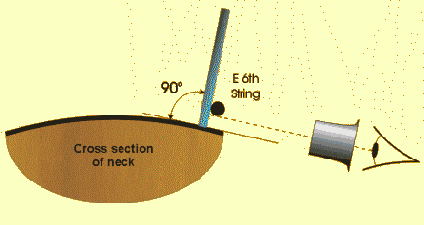
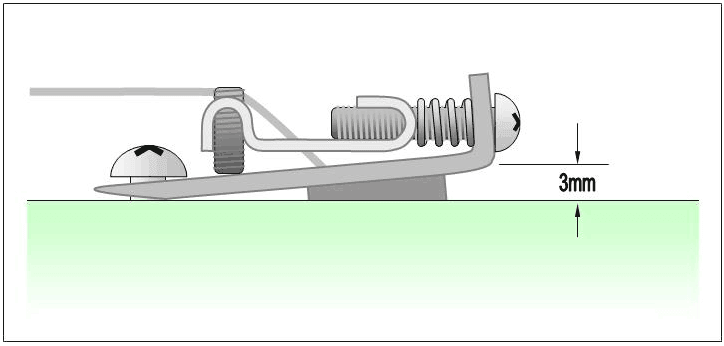
INTONATION adjustment:
After you have done all this stuff take a look at the intonation of the strings. Ideally, you need a tuning meter to do this accurately, and make sure the strings are in good condition. During use, strings accumulate dirt, grime and rust on the bottom side where it can't be seen easily so lift the string and gently run your finger under the string in the area you play on; it should be smooth. If they are rough or less than smooth, the strings can't possibly play in tune so replace them. Then tune the open string to zero on the meter scale and then play the 12th fret, the meter should read zero again. If it reads sharp then adjust the saddle away from the 12th fret and keep checking and adjusting until it reads zero for both tests. If it reads flat then adjust the saddle toward the 12th fret and keep going as previous until it is corrected. Work your way through all the strings one by one.
NOTE: Moving the saddles significantly can cause the bridge angle to rise or fall causing the action height to change and the strings to lose tune; the vibrato springs have to be adjusted to reset it. This whole operation is a bit like a dog chasing it's tail so you have to persevere before things come good, but once it stabilizes then it's good forever
String choice.
I recommend you use the biggest strings you can handle. Remember that SRV used .013 to .058 (Detuned to Eb); He didn't struggle with heavy strings like that for nothing. Thin strings produce more squawk and less output and in general sound pretty terrible. A good compromise between heavy and light and my personal favourite set is the .010 - .052. These are easy to bend on the plain non-wound strings but have a nice full bass sound with lots of twang and output. Remember that if you change gauges of strings the set-up will have to be revised as the neck and bridge adjustments rely on a given string tension, if that changes then so do the adjustments. As for brands, it's a personal choice as some strings don't like the chemistry of some players and won't last more than a few hours. Try different brands until you find the one that works for you.
Good luck
This page has been intended only to be guide, if you get into difficulty I suggest you consult a high quality, extremely competent repairman with a lot of experience. There are a lot more complications and finer points not discussed here as a small book could be written on the subject. Have fun, stay cool and don't smash your guitar (in frustration). Hope you like all this stuff.
All my best in AVn-Sound,

Chris Kinman.
Problems with install?
Consult this Harness Diagnostics page that will guide you to solving problems.
Consult this Pickup Diagnostics page that will guide you to solving problems.
'NOTE: This information is copyright and must not be used for commercial purposes by any other party. Chris Kinman (c) 1998.
UPDATED 2-Apr-2024 Expanded Radiii Offered
See Radius Gauge
Compound Radius explained
How we match our magnets to different fretboard radii, including Warmoth 10-16" compound radius
It has been said that vintage pickups sound so good because they have certain imperfection, such as excessive string pull resulting in string crash and buzz, pitch instability (Strat-itis), overbearing G string that sounds like a chain saw, 60Hz noise etc etc. However I strongly disagree. I reckon they sound so good because of some fundamental electrical characteristics and that they sound great in-spite of these imperfections .. in fact they sound far better without those imperfections.
Basics: The distance between a string and magnet determines the loudness of the string so one might conclude that to get excellent balance of string output levels the magnets should all be the same distance from the strings. But fretboards are usually radiused (arched / cambered) and since the strings follow that radius we find magnets of different lengths arranged in an arc (ostensibly to match the arc of the strings). However, in practice some strings generate more output than others. For example the non-wound G string of modern string sets is much louder than any other string, the B string also is somewhat louder while the D string is somewhat softer. That's the reason pickups have magnets of different lengths (staggered) to compensate for the strings that are louder than others, so that all strings sound balanced.....ie they all have the same loudness. Another significant aspect of this story is that Leo Fender designed his fretboard radius for playing comfort, with a tight radius of 7-1/4", which is easy for fingers to form bar chords.
Problems: The traditional stagger of old Stratocasters was originally designed for a wound G string that was predominately used in the 50's and 60's. In the late 60's the Blues influenced musical styles and guitar players began stretching notes upwards by bending the strings. They soon discovered that a non-wound G string could be stretched (bent) far easier and further than a wound one. But a non-wound G string is a rogue and has dramatically more output and the increase in volume means it dominates all the other strings. It jumps out and can be heard as the loudest string, standing out dramatically in licks, runs and chords. This rogue string also misbehaves in terms of not oscillating at a stable frequency. And because of it's mass and low tension, it tends to succumb to the magnetic influence of the pickup and at elevated levels sounds akin to a chainsaw or buzzsaw. This is especially true with Class-A amps. This is actually a combination of the string crashing into the frets and frequency instability (Strat-itis). So we end up with a mix of Strat-itis and fret crash, I can't imagine anything more horrible and un-musical. This also translates into distortion sounds and, as with clean sounds, it is really quite objectionable and unpleasant (very un-musical). Pickup manufacturers never caught up to the modern style of playing and retained the old out of date stagger, many still to this day.
However a geometric problem exists with extreme stretching on Leo's 7-1/4" radius fretboard in that strings tend to bottom onto the frets resulting in choked (deadened) notes, particularily in the upper register. Players compared experiences and noticed that flatter fretboards like Gibson's 11" radius did not have this choking problem. Realizing the advantages of a flatter radius some manufacturers (who were looking for a gimmick to increase market share) conceived the compound radius. Done sensibly, a compound radius is a clever way to combine the comfort of Leo's fretboards in the lower register with the aniti-choking properties of Gibson's fretboards in the upper register. However not all compound radius are sensible and some actually create another problem with string output imbalance. The result is the G string is excessively loud and the two E strings are excessively soft when pickups have a vintage magnet stagger. Using non-staggered magnets improves balance somewhat but still there is the big difference in output between the G and D strings as well as a significant difference to the other strings.

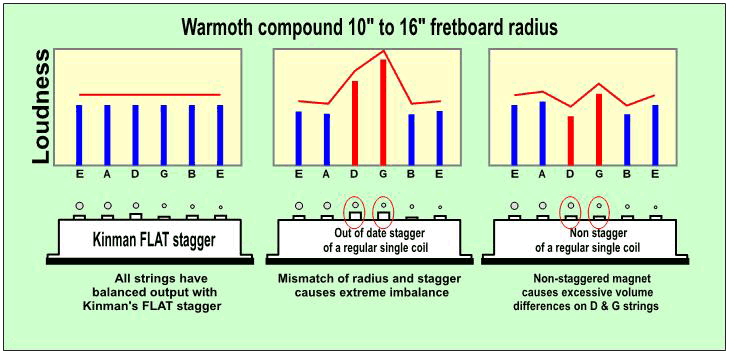
Solutions: One magnet stagger can't possibly match all the different fretboard radii options available on modern guitars. Magnet staggers are set at time of manufacture and can not be changed, so to solve this dilemma we offer two radius options. First is the (fully compensated) stagger in the 7" to 14" radius range that suits most guitars (such as Fender, Musicman, G&L etc, see Table below). This can be ordered to suit non-wound and wound G strings.
NEW July-2008: The other is specifically designed to suit Warmoths 10-16" compound radius fretboard or any flatter fretboards ranging from 14" to 20" (see Table below). The Kinman flat radius staggered magnet array is engineered to compensate the D and G strings for balanced output with all other strings. It's a perfect solution and is much better than regular non-staggered magnets.
In March 2024 In response to the latest trends I expanded the range of fretboard radii and magnet staggers to include the following ...
All measurements are M@LF meaning measured at last fret.
All can be ordered to suit non-wound and wound G-3rd strings.
All Kinman magnet staggers are engineered to compensate the D and G strings for balanced output with all other strings. It's a perfect solution and is much better than regular non-staggered magnets.
ORIGINAL FENDER and COPIES (M@LF)
OTHER uniform radii
WARMOTH
OTHER Compound radii
NOTE: When a wound G string is used with a magnet designed for non-wound string the wound string will have significantly lower output. If you contemplate alternating both types of string it's better to choose a stagger for wound G string. When you are using the non-wound string it will be louder than the others but that is preferable to one that has lower output.
Special note about Jimi's Reverse Stagger: We believe Jimi got his sounds in spite of the reverse stagger and that he just learned to live with it. So we do not recommend a reverse stagger to emulate Jimi's sound. All this does is lower the output of the A string and that's definitely not very pleasing. If you want to emulate Jimi's sound you will be thrilled with the hendrix set and once you hear them you won't regret not getting Jimi's reverse stagger, I promise you.
The radius range is marked on the base of the pickups as well as on the label in the box. The table below gives you a rough guide as to the radius of some common guitars. If your's is not listed please "Contact Us" to have it included on this page
- RADIUS CHART -
All radius can be supplied in either Right or Left hand.
| RANGE range in inches | BRANDS and MODELS |
|
Improved stagger 7" - 14" |
All Strats* including those with Floyd Rose bridges, Japanese Squiers*, G&L, Fernandez, Tokai, Korean Squiers, Musicman, Yamaha Pacificia (standard) and most other guitars with traditional bridges. Not PRS bolt on neck models. |
|
Non-staggered 15" - 20" |
Warmoth 10"-16" compound, Yamaha Pacificia (only their compound neck), Parker Fly: check Parker website >Resourses >Specifications >Model >Fretboard shape (most seem to be either 10"-13" or 10"-15") Bill Lawrence. |
Check your radius, if you're not sure what it is, better shops and good repairmen quite often have radius gauges that can measure this. If you prefer to measure it yourself, download the instructions and templates below.
INSTRUCTIONS FOR MEASURING THE RADIUS OF YOUR FRETBOARD.
Below you will find a number of files containing a fret board radius gauge which looks a bit like this: Choose the most appropriate file and follow the next paragraph. Or you can screen shot or SNIP and print it.
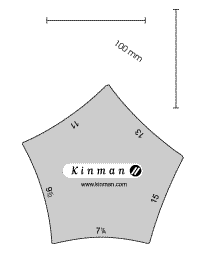
Print the image and confirm the horizontal and vertical lines are equal length and then using scissors or an artists scalpel, carefully cut the radius out as neat and accurate as possible. Then, after loosening your strings, find which of the templates fits the radius of your fret board the closest. If the curve only touches the middle of the fret board then it is too big, if it only touches the sides then it is too small.
It is important to get within one of our ranges; Standard 7 - 14 inch or Compound/Floyd 15 to 20 inch. Specify which one when ordering or purchasing your new Kinman pickups. The radius range is marked on the display box as well as one the base of the pickups.
| "Ding formatraws" | These tend to be smaller but you really need some CAD or drawing software to print them. In general, if you don't recognise the format then you probably can't use it. | |
| radius.pdf | 12 kb | Adobe Acrobat - Portable Document Format |
| radius.cdr | 19 kb | Corel Draw |
| radius.wpg | 13 kb | Word Perfect Graphic |
| radius.wmf | 41 kb | Windows Meta File |
| radius-pc.ai | 64 kb | PC version Adobe Illustrator |
| radius-mac.ai | 64 kb | Mac version Adobe Illustrator |
| radius.dxf | 70 kb | AutoCAD |
| "Bitmaps" | These are larger but as long as you make sure your printer resolution is set right you shouldn't have too much trouble with them | |
| radius300.gif | 41 kb | 300 DPI compuserve-Graphics Interchange Format for printing on a laser printer |
| radius300.cpt | 169 kb | 300 DPI Corel Photo Paint for printing to a ink laser printer. |
| radius300.eps | 2.0 mb (huge) | 300 DPI Encapsulate PostScript for printing to a Mac laser. |
| radius360.gif | 52 kb | 360 DPI compuserve-Graphics Interchange Format for printing on a ink jet type printer |
| radius360.cpt | 219 kb | 360 DPI Corel Photo Paint for printing to a ink jet type printer. |
| radius360.eps | 2.8 mb (huge) | 360 DPI Encapsulate PostScript for printing to a Mac ink jet. |


NOTE: This info is copyright and must not be used for commercial purposes by any other party. Chris Kinman (c) 2000.
Have you stumbled across a word and you don't know what it means? Well, you've come to the right place. Click on Sonic or Technical above to see a comprehensive alphabetical listing of this Pickup makers terminology. The terms have been used here in the context of electric guitars, they can also apply to other topics.
There is a lot of additional information below so please scroll down or use the following shortcuts to read it all. For more detailed Technical information and Tips (and handy hints) look in my pages.
AVn = Anthentic Vintage noiseless
Hx = Hum cancelling
Zero-Hum = no 60Hz hum
An Introduction to Kinman Stratocaster* pickups
What's wrong with regular single coils?
String/Magnet alignment issues and my solutions
Bypass filter for Volume pot (treble bleed)
Compressors (impact on sound)
Covers and Logo stuff & removing them
Dimensions
Gold plating (discontinued)
Hi string Lo string presence balance
Improvements
Installation and wiring
Jimi's reverse stagger (avoid it)
Lead Free manufacturing RoHS compliant products
Leftys
Magnets that are unique
Magnet staggers IMPORTANT
Magnet/String alignment improved
Mounting hardware
Mounting to wood with No pickguard
Mustangs (special pickup requirements)
NoLogo for tinted covers
NoSoldering Harness (pre-wired harness with K7 or K9 sound switching requiring NO soldering).
Return for exchange policy (I want happy customers ...)
S1 switching system by Fender (how to swap pickups)
Secrets of amazing TONE
Soldering tips Star grounding, is it necessary?
IMPORTANT: All my *Fender replacement pickups use Alnico rod magnets because Alnico imparts a rich complex midrange detail that alternate magnet designs just don't have.
Click here to see more Custom Strat Sets
NOTE: In December 2001 I made some dramatic changes/improvements in my pickups for Strat* which result in an increase of presence/brightness, attack and output. The changes are coincidental to another change, that of changing the coating on the Magnetic Shields from Gold Passivate to chemically etched Black. The magnetic shields are the two formed-sheet-metal parts that surround the coils and can be viewed in the pictures below. The improvements are the consequence of us now manufacturing these crucial components 100% in-house in our own metal press shop so we can control quality and other important aspects of their manufacture which is impossible with outside suppliers.
Lead Free manufacturing: As of August 2006 we began the transition to RoHS compliance; that is our products are manufactured to comply with the new international standards to be free of lead, cadmium, mercury, hexavalent chromium, polybrominated biphenyl (PBB) and polybrominated diphenyl ether (PBDE). All products will be fully compliant by end of 2006. You will see this symbol printed on the back of the pickups or harness parts.

Lead Free products use SAC solder (Silver and Tin) and are soldered at a temperature of 700 degrees F. NEVER mix Lead solder and Lead Free solder. If a lead free product is repaired and re-soldered with leaded solder then long term reliability can not be assured.
Returns for exchange: I like happy customers telling the world what great pickups I make and am prepared to exchange if the results are not as dramatic as my customer hoped for. The details are located on the *Terms and Conditions* buttons on my Shops Online.
Kinman's unique low strength Alnico-5 magnets (unlike American manufacturers who use Chinese magnets for economy mine are expensive and most definitely not made in Asia)
On regular single coils for *Strat's and *Tele's the Alnico-5 magnets are quite strong, too strong to allow natural string vibration patterns. The result is reduced sustain and a kind of warbling sound from certain strings (the G-3rd and E-6th strings are the worst affected) that is actually a range of discordant frequencies mixed together, not a pure steady note of a fixed pitch (see Strat-itis). And because the magnets pull the strings down onto the frets (resulting in strings crashing into the frets) Fender's are notoriously buzzy/rattly instruments and sustain is cut short by the loss of energy from the strings.
Kinman's unique and special Alnico-5 magnets on the other hand have 35% less magnetic pull that allows the strings to vibrate freely and purely. Sustain is noticeable longer and there is negligable Stratitis. And because the strings are not pulled into the frets by the magnets the sound is amazingly devoid of buzzes and rattles and crashing of strings into frets.
This is not magnet aging or simple degaussing, this is a metallurgical difference in the material itself...a difference that you will hear the moment you first hear Kinman's. And incredibly output is not sacrificed with the reduction in magnet strength. You will be astonished at the strong output, longer sustain, increased clarity and purity of sound that your guitar will produce when you fit Kinman's. This is how your guitar sounds when the strings are not hampered by excessively strong magnets.....as many thousands of players have discovered to their delight.
High string/Low string presence difference solved.
As of December '02 all Kinman pickups will be shipped with an improvement that guitar players will love. Many players complain that if they set their amp up for killer wound string sound their un-wound strings literally slice their ears off with excessive ice pick. But when they adjust the amp to make the un-wound strings bearable they loose the great tone they had on the wound strings. There seemed to be no-where in between. Other manufacturers have addressed this by using Alnico-5 magnets on the wound strings and Alnico-2 magnets on the un-wound strings, but having different magnets changes the overall sound and results in a new type of pickup.
I have found a way of keeping the highs sweet and the lows crisp without using different magnets in the same pickup. Resistance, inductance, resonance, magnet strength and Q are unchanged so this little secret of mine can't be detected other than by listening. The wound strings on my pickups have all the snap and attack that you'd ever want but the plain treble strings produce a nicely balanced sweet tone that won't offend ears. And most importantly, tonal and response balance is not compromised as it is when different types of magnets are mixed to solve the problem.
The SECRETS inside a Kinman pickup for Stratocasters*:
I occasionally get asked why my Hx Strat pickups are more expensive than regular single coils or even some other brands of noiseless pickups;
There are 30 parts in a Kinman Strat pickup, a normal single coil pickup has only 11 and other brands of noiseless have just 22. More parts means better performance so lets talk about value for money and how Kinman's will actually help to pay for themselves. The reason these are expensive to manufacture is several fold:
1) I do not use molded plastic parts to form the coil bobbins. My bobbins are assembled one at a time by hand using individually drilled and routed flanges that are skilfully hand de-burred and radiused around the edges one at a time. These flanges are made from extremely inflexible (and expensive) material that is made specially for me and is much stiffer than even the best moulded plastic parts. Molded plastic parts are used in economy brands but I get far better performance using my special parts and painstaking hand assembly. My special black material is most definitely not the usual inexpensive vulcanized fibreboard which is stamped out enmasse at very low cost.
2) my pickups are 3 or 4 times more complicated than regular single coils and have more parts than other noiseless; simply put more parts means better sound. Economy brands have less parts but don't sound as good. There is actually more than two regular pickups inside one of my pickups. (see photos below)
3) My designs have extra components (magnetic shields, steel pins and stamped steel H-core parts) which are present to prevent magnetic coupling of the coils which is the deadly enemy of verticle noise cancelling designs. Consequently my pickups require much more time, effort and equipment to manufacture and to maintain strict quality control on every one of them. My products feature jewell-like precision attention to detail which will be your pleasure to discover and experience.
4) Most of the materials and components used in my pickups are specially made for me to my rigid specifications and are the highest quality available anywhere. I avoid off-the-shelf components and materials to achieve better than off-the-shelf perfomance and sound.
5) I also include a high quality tintable cover and 2 sets of specially made mounting screws (Pan head and Countersunk) for each pickup to suit different types of guitars as well as the parts to make my Bypass filter, all nicely presented and packaged. Ohh yeah!!! and eack pickup is fitted with a unique shielded cable already prepared ready for soldering into your guitar. These cables are more than long enough for stock strat installs. Quality of design and manufacture with forethought and attention to detail all the way, and then some.
Many players have noticed that after they fitted Kinman's their strings last longer, up to twice as long (depending on your body chemistry). That means the Kinman's will help pay for themselves and eventually save you money.
Now for the inside story: Picture #1 shows a partially exploded view of what is inside. A regular single coil is the equivalent of the assembled magnet bobbin (bobbin at left) without all the other things. I use six Alnico magnets and therefore must also use my Patented magnetic H-shield to ensure a faithful reproduction of Alnico single coil noiseless tone than can work happily into a 250K volume pot.
The hand assembled magnet bobbin, upper magnetic shield, lower magnetic shield and hand assembled noise sensing bobbin. Note the Blue insulation sleeve around the magnets on each end of the bobbin, this is an industry first. This specially manufactured precision sleeve is extremely thin but prevents shorting of the coil to the magnets (a common problem with other brands).
We manufacture our own magnetic shields in-house on 3 different Power Presses (35 ton to 12 ton strike force) to ensure the highest quality standard. We also do this because no outside supplier has the other special equipment necessary to complete these crucial parts. These parts are not painted because paint affects performance, I use chemical etching Black stuff that adds ZERO thickness.
Note how there is actually more than 2 regular pickups in one. That's real value for money huh!!!
This is how it would look if assembled before winding the coils into the bobbins. Note the 8 steel poles (unaged models have 10) in the noise sensing lower bobbin (right) and the 6 special Alnico-5 magnets in the string sensing upper bobbin (left). The 8 or 10 steel poles boost the efficiency of the noise sensing coil by over 200% compared to what alnico magnets would yield, and that means the coil can be less than half the size. Minimizing the lower coil reduces it's adverse affect on the signal to almost zero.
The two coils are very different to each other, being wound with different size wire and vastly different turns count (unlike regular stacks which have similar coils) but each generates the same noise voltage and therefore cancell noise perfectly. The lower noise sensing coil has less than half the number of turns and less than 1/3rd the resistance of the string sensing upper coil, reducing it's undesirable affect on the sound to almost zero. Here the bobbins have been assembled, the wires terminated and it has been vacuum wax potted at 120 degrees C.
We indellibly print and write a lot of identification data onto the back of every pickup so you won't ever forget what it is. Every pickup has a (green) copper ground plane over the baseplate, this helps shield the coils from RF noise (buzzing).
Soldering tips: >Soldering tricks.
Aging tints: As of December 2000 Kinman pickups for Strat are fitted with a new design pickup cover which is moulded in either Black or a special White plastic that's capable of being stained to a variety of colours. As well as Black and White I also offer Mint, Aged White, Parchment, Old Strat, and Cream. See my Glossary Aged Covers for full details. As of May 2006 most of my colours are moulded into the plastic during manufacture and the colour is very uniform.
I do not offer metal plated covers for Strat pickups. Real metal plating affects the sound excessively and Metallized deposits that dont affect the sound like my Tele cover require a special plastic which requires it's own prohibitively expensive injection molding tool.
No Logo covers: (May 2006) No logo covers are specially made that way. NOTE: when you order pickups without Kinman Logo you will be charged extra.
CAUTION: Do not attempt to fit foreign replacement covers to Kinman pickups. Some of these foreign replacement covers are not faithful reproductions of Fenders and are too small and will fit too tightly onto Kinman bobbins. Often these covers destroy the bobbins when attempting to remove them.
Removing covers requires special knowldege. Click on this to learn how to remove covers without damaging the pickup.
String alignment issues and Narrow & Intermediate magnet spread pickups:
As of 22-Oct-2008 all stock sets will have an Intermediate magnet spread middle pickup. This provides a gradual narrowing of the magnet spreads from Standard bridge (52.5mm) to Intermediate middle (51mm) to Narrow neck (49.5mm). This means strings will align better with the magnets regardless of bridge saddle spacing. When ordering a 'Single' pickup, 'Two' pickups or 'Mixed set of 3 Strat pickups' you have a choice of any magnet spread. Click to view a PDF diagram of these 3 magnet spreads.
As of mid March 2001 all Kinman Strat sets are being shipped with a special neck pickup that has the E poles 3mm closer together. This means that the magnet-poles of the neck pickup will align satisfactorily* with the strings on both Twin Pivot AND Traditional type bridges made by Fender and others. Strats with either bridge will have improved performance with no more dropouts on the E strings and better bending performance. *I consider it satisfactory when the strings align within the perimeter of the magnet. It's OK if the strings do not lie on the dead centre of the magnets.
Only genuine Kinman pickup covers will fit because the pickups with narrow and intermediate pole spacings have a matching cover.
Customers with vintage instruments can have all 3 pickups with normal magnet spread by using 'Mixed set of 3 Strat pickups' order channel on the shop.
More on string/magnet alignment
String/magnet alignment is not associated with fretboard radius as some believe. To understand string/magnet alignment you must be aware that the strings are not parallel but are wide apart at the bridge and closer together at the nut. This taper causes the primary alignment issues and can be compounded by saddle mis-alignment too.
My neck pickup has narrow magnet spread and aligns at the neck position with strings coming off most bridge variations. The middle pickup has Intermediate magnet spread The bridge pickup has standard Fender magnet spread which is used in most replacement pickups and also suits most bridges. Fender's original single coils come with only standard magnet spread and cause severe misalignment problems with neck pickups when used with their narrow bridges or other types of bridges.
The Kinman middle pickup usually has a standard magnet spread too, and rarely has an alignment issue. On rare occasions when we get asked we will use a pickup with narrow magnet spread instead if the bridge has narrow string spread. We don't practice this habitually because it is rarely a problem. Soon I am introducing pickups with an intermediate magnet spread for middle pickups that should work with all bridges.
Misalignment is often caused by narrow bridges but the reason for excessively poor string/magnet alignment could be the saddles or it could be pickguard mis-positioning or neck/body mis-alignment.
Unfortunately saddles often drift to one side when they are not set horizontally. Make sure the grub screws are adjusted so the saddles sit horizontally. It is also legitimate to adjust the saddles with a deliberate lean to re-position the string in a more desirable alignment.
Discontinued 2009 due to reduction in prices. (From July 2001) all pickup sets have included for FREE the 130K resistor and the .0012uF capacitor to make the volume control bypass filter. This device, when used with Kinman pickups, actually increases the brightness slightly as the volume pot is wound down, making it great for volume reduced rhythm chops. When used with regular single coils it more or less attempts to preserve the amount of brightness as the volume pot is wound down. Read more about it here
NOTE: All Kinman pickups are available in 6 options. Learn all about my magnet staggers and my new Flat Radius stagger for Warmoth compound fretboards here.
All bridge pickups made since March 2004 have got a lower 5th string (A) magnet than the neck and middle. These pickups have a 'b' suffix attached to the model ID (eg AVn-69b). This alleviates the nasty gnarling sound prevalent in Fender type pickups (non-noiseless and noiseless). The volume of the strings remains well balanced.
Special note about Jimi's Reverse Stagger: I believe Jimi got his sounds in spite of the reverse stagger and that he just learned to live with it. So I do not recommend a reverse stagger to emulate Jimi's sound. All this does is lower the output of the A string and that's definitely not very pleasing. If you want to emulate Jimi's sound you will be thrilled with the Woodstock's performance and once you hear them you won't regret not getting Jimi's reverse stagger, I promise you.

Click on the photo for a larger view. Discontinued 10-April-2007. We still have some stock left, when you order ask for availability in the Additional Notes box.
My Gold plated poles and screws are double plated with Nickel first and then double plated with Gold on top of that. This makes them more resistant to wear and corrosion that regular Gold hardware. You can see a photo of a handsome Strat Deluxe with Gold Kinman pickups by following this link Gold has an additional cost of US$50 per set. Direct sales only.
Pan head screws are included by default, however upon request we will include Countersunk screws for vintage and re-issue models. All sets contain 6 special springs, prepared ready-for-soldering shielded output socket cable and cable ties to make a neat job plus comprehensive Fitting Instructions and various Wirograms are not included because of size and weight but we send you an Install Inormation email when your order ships.
No pickguard mounting to wood.
If your original pickups are EMG or similar pickups with parallel baseplate and your pickup cavities will not accomodate the normal offset asymetric baseplate of a regular Strat pickup then click this to see how to provide for normal baseplates.
For mounting with out a pickguard direct to the wood it is imperative that no foam (or very little) is packed under the pickup as spring material. The correct method is for the Silicon rubber tube springs we provide to be placed over the screw between the wood and the pickup (do not use metal springs as they might short the signal). Excess pressure resulting from using foam packing under the pickup will lead to mechanical de-formation (bending) and eventual failure of the pickup. A minimal amount of low density foam to help align the pickup from leaning is OK. Click here to see how it's done.
To learn specific and detailed info about the types of screws to use I recommend you Log-in to >Tech Support >Install Info > Mounting pickups without pickguard, direct to wood.
Installation and Wiring: (Scroll down for my innovative NoSoldering Harness that eliminates wiring and soldering)
Installing Kinman's is straighforward. However you should check your pots with a multimeter to ensure they measure a minimum of 240K ohms. My pickups work with all the original controls and the hook-up cables are already generously cut to correct lengths (tip of cable and ground take-off leg) and are pre-soldered to suit most Strat* and Strat-like guitars. If you have non-standard control positions (Volume pot and/or selector switch) and require longer cables tell us when you order in the Additional notes box on the Checkout page. You will need soldering skills and a soldering iron, a screwdriver for cross head screws and a tube spanner to tighten the pot nuts and output socket nut. Comprehensive fitting instructions are included and are very detailed with easy to understand wirogram drawings (you can view these at Tone Workshop >Tone). Changing covers, shielding and setting up is also discussed in the instruction text and on the Tone Workshop pages of this Website.
I urge you to learn how the pickup ground cables should be terminated onto the volume pot by visiting Soldering tips in >Tech Support >Install Guides. It teaches NOT TO HEAT THE ENTIRE section of the exposed ground take-out point as this can cause short circuits.
A list of recommended installers for the USA can be viewed on My Dealers >USA.
Star grounding, is it necessary?: Star grounding in a guitar is not the absolute necessity it is in 'active circuits' like CD players or Amplifiers where it is designed to inhibit ground loops. Guitars don't suffer from ground loops. It is practiced in guitars more as a convenience that serves simplicity, convenience and neatness of wiring. That means as long as all the ground wires ultimately connect to the output socket ground terminal all will be OK. In some circumstances it may be more convenient to piggyback some ground wires onto an intermediate grounded point that is different to the central main ground point on the cover of the volume pot.
Fender's S1 switching system. Upon request with order for pickups I can provide special wirogram and fitting instructions developed especially for fitting my pickups to any SSS Strat that is equipped with Fender's S1 system (not SSH). NOTE: only pickups manufactured after June '04 are compatable. I do not supply the S1 switch and the S1 system will not assimilate with my NoSoldering Harness because they are similar products.
Left hand pickups and NoSoldering Harness with left hand pots for left handed players are available at slightly higher prices.
I have been told many times by customers that they use compressors to 'even out the response and level irregularities' of regular single coils. Of course this kills some of the 'feel' and 'explosive attack' of a single coil by limiting dynamic range. Kinman pickups don't have these irregularities so there is no need to use a compressor, this means you will get all the dynamics that Kinman pickups are famous for and you will notice a vast improvement to your guitar without a compressor.
Mustangs respond very well to pickup upgrade because the original pickups are of student quality and do not let the guitar achieve it's full sonic potential. You can now enjoy radically improved sonic performance by fitting Kinman Mustang pickups and rewiring the two slide switches to perform more useful functions. Rewire with my special Mustang wirogram and you can have Neck and Bridge in series with output boost and get a P-90-like crunch as well as Neck and Bridge in parallel, or each pickup individually. Wirogram is only available with new direct orders and will be included with your order for pickups. Order on Shop Online in the 'Custom set of two Strat pickups' box. The original switches provide either, or both pickups in phase and (honky) out of phase.
When ordering choose Mixed set of 2 Strat pickups on the new shop. It is important you tell us you have a Fender Mustang to get the most suitable versions of my Strat pickups. Neck pickup should have Narrow magnet spread (49.5mm) and the bridge pickup should be Standard magnet spread (52.5mm). The original bridge pickup is reversed (left-hand turned around) but we have addressed this idiosyncracy with out parallel baseplate.
Magnet/String alignment improved

Fenders modern twin-pivot bridge such as fitted to their American Standard and American Deluxe series has a narrower string spacing than a vintage 6 point bridge. The modern bridge is too narrow for regular Strat pickups and causes the strings to misalign with the magnets in the pickups, the neck position pickup is worst affected because one of the E strings is a lot lower in volume than the other 5 strings.
In mid March 2001 Kinman introduced a special neck pickup that has the E magnets 3mm closer together. This means that the magnet-poles of the neck pickup will align satisfactorily* with the strings on both modern Twin Pivot AND Traditional Vintage 6 point type bridges made by Fender and others. Strats with either bridge will have improved performance with no more dropouts on the E strings and better bending performance. *I consider it satisfactory when the strings align within the perimeter of the magnet. It's OK if the strings do not lie on the dead center of the magnets.
On 22-Oct-2008 Kinman introduced a further improvement, an Intermediate (51mm) magnet spread for the middle pickup. This provides a gradual narrowing of the magnet spreads from Standard bridge (52.5mm) to Intermediate middle (51mm) to Narrow neck (49.5mm). This means strings will align better with the magnets regardless of bridge saddle spacing.
The bridge magnet spread remains unchanged at Standard 52.5mm, the same as all Fender and replacement Strat pickups from Duncan, DiMarzio, Lollar, Fralin etc All of these Strat pickups have unacceptable string/magnet alignment of the neck pickup when used in conjunction with narrow bridges from Fender, Wilkinson and Floyd Rose. Kinman is the only brand of pickups to have this much needed refinement.
When ordering a 'Single' pickup, 'Two' pickups or 'Mixed set of 3 Strat pickups' you have a choice of any magnet spread. Click to view a PDF diagram of these 3 magnet spreads.
Covers (bold): Only genuine Kinman pickup covers will fit because only Kinman makes Strat pickups with Narrow and Intermediate magnet spreads.
More on string/magnet alignment (bold)
String/magnet alignment is not associated with fretboard radius as some believe. To understand string/magnet alignment you must be aware that the strings are not parallel but are wide apart at the bridge and closer together at the nut. This taper causes the primary alignment issues and can be compounded by saddle mis-alignment too.
Misalignment is most often caused by narrow bridges but the reason for excessively poor string/magnet alignment could be the saddles or it could be pickguard mis-positioning or neck/body mis-alignment.
Unfortunately saddles often drift to one side when they are not set horizontally. Make sure the grub screws are adjusted so the saddles sit horizontally. It is also legitimate to adjust the saddles with a deliberate lean to re-position the string in a more desirable alignment.
Miscellaneous electrical circuits and guides that don't belong elsewhere.
Converting a Kinman 2 Conductor Strat pickup to 3 Conductor.
Sonic
NOTE: This info is copyright and must not be used for commercial purposes by any other party. Chris Kinman (c) 2000.
Pickup makers Dictionary - Sonic terms.
Referring to specific old Strat pickups wound with Formvar wire:> The tonal characteristics developed with the passing of time and the aging and subsequebt degradation of the Formvar insulation. Usually softened attack, loss of the characteristic Strat low mid scoop, lowered Ice-pick-in-your-Ear brittleness and lowered dynamic range which results in earlier breaking into distortion yielding a creamy distortion when overdriven and a sweeter treble when played clean. The aging I'm referring to is not the result of magnets aging. New single coils cannot be aged artificially in the same way since this can only happen in the fullness of time. However, certain things can be arranged in a single coil to approximate Aged tone BUT usually this results in some unwanted side effects (less harmonic richness). My Hx pickups have certain design elements that I have manipulated to replicate genuine aged tone. Ironic ain't it? That a high-tech noiseless design can generate authentic aged tone whereas a single coil has to wait 20 years to age naturally. For story of discovery of Aged Sound click here >* Aged Sound fully explained * See also Degaussing in Technical and Non-aged sound immediately below.
NOTE: Kinman pickups are age stable: that is they will not age noticeably, even over a long period of time.
The tight sound of a high quality new Strat pickup that is very snappy with rapid and explosive attack response, low mid scoop and piano mid-tones. For low to medium level playing (clean) the generous attack is a desirable characteristic since it provides presence, projection and a stimulating response along with very nice piano mid-tones on the wound strings (precursor of twang). Highs are pristine clear and rich in harmonics. The sound resists crunching too easily under heavy pick attack. All of this happens when the strings are picked in a certain way and can be de-intenfied with appropriate picking technique and choice of plectrum.
Click here to learn how to remove covers safetly from Kinman Strat* pickups
You can order your pickups with covers pretinted from my factory for an additional cost. These are moulded with the colour and so are permanent and non-bleachable colours.
DIY tinting of covers: Kinman's current Strat pickup covers are moulded in a special plastic that can be semi-permanently tinted with water based dies such as Tea, Coffee, Curry, Henna hair dye etc. Some colours that can be made this way are .......
You simply degrease the covers first with kitchen detergent or lighter fluid and then soak the White covers in the above (boiling temperature) food solutions for anything from 10 seconds up to several minutes. There is no need to keep the solution on the boil. If stronger colour is desired simply allow more time, up to several minutes. If the colour is still not strong enough than add more coffee/tea/stain. If you make a mistake then reverse the process by soaking the cover in Laundry bleach and start over. The resulting colours may change with time and exposure to light.
Do not attempt this with old Kinman covers as they will simply melt. The old covers can be identified by the notch taken out of the bottom of the cover, in other words the bottoms of those covers are split into two planes.
Caution: we can not guarantee all covers that have Logo will stain satisfactorily as the stain might not work due to the application of a conditioner intended to allow the logo to stick. In this case the covers can be reverted to original color by bleaching as above. Covers without Logo will stain without difficulty.
Covers are Standard with Burgandy printed Ink logo. Covers are also available without Kinman logo by special request (same price). Logos sometimes wear off the covers and will leave a white witness mark if the covers are tinted.
The new covers also do not have sharp edges at the top (but it's not rounded over noticeably), covers the lower coil completely and is more flexible than the previous cover. These new covers conform to early Fender specs in every way so it's no longer necessary to fit old covers to my Strat pickups for that authentic old look.
NOTE: Covers from other manufacturers can not necessarily be tinted this way, and neither can pickguard materials or knobs.
The term applied to a pickup that describes how the response of the pickup feels and sounds to the player. More air means more expression, more lively, more satisfying to play with. See also Attack , Dynamic Range .
The short-lived instantaneous peak voltage response from a pickup at the precise moment the string is plucked. A direct equivalent of dynamic range and Q. More attack means the note will explode from the speaker with more energy. Excessive attack contributes to hearing loss because of the spike of power delivered by the loudspeakers. See Dynamic range , Air and Presence .
Combination of midrange dominance and hard attack. Often associated with hot pickups and P-90's. A kind of Twang without bite. Like the bark of a medium sized dog.
Audio Frequencies below 200Hz.
Ever really thought what a big church bell really sounds like? Huge, lots of shimmer, ring and presence but not really a lot of treble or bass. Big Bells are midrange dominant.
The ability of a tone to be noticed by virtue of it's treble/midrange pleasingly gritty edge. One that bites or cuts through with a cutting edge of presence derived from Alnico magnets. Like the bite of a small sized dog. See also Presence , Attack .
The pleasing result of a specific presence factor of a pickup in expressing a group of concordant notes particularly in the upper register on the non-wound strings where the notes 'chime' together to capture that quality of a large bell. Often associated with a high quality single coil Fender style pickup using Alnico magnets. Noiseless alternate magnets deisgns such as Ferrite and Samarium Cobalt have less chime than regular single coils or Kinman noiseless.
A kind of presence imparted by the presence of twangy midrange. Eg Our Humbucker-Tron has excellent chirp on all strings whereas Filtertrons lack it on the low wound strings.
A kind of presence imparted by the presence of twangy midrange. Eg Our Humbucker-Tron has excellent chirp on all strings whereas Filtertrons lack it on the low wound strings.
Sometimes applied to sound that is unprocessed, undistorted OR devoid of noise. See also Noise .
Tone that has no distortion content or without excessive midrange and subsequently a high transparency factor. See also Transparency .
Usually applied to the presence (or abundance) of midrange frequencies which tend to muddy the tone. See also Transparency . Alnico magnets do provide midrange complexity but remarkable this is no muddy.
The intentional limiting of dynamic range by electronic methods to control large transients of audio power so as not to exceed the limits of devices such as recording equipment; also a characteristic of a guitar pickup when the peak frequency envelope is wide with the result it drives the amp into slight overload. In the extreme can also refer to the undesirable strangled feel or excessive lack of response and dynamic range from a pickup which is the result of poorly designed hum canceling techniques in single coil design, but not with Kinman's.
Smooth unvarying (steady) distortion. Not warbling or rasping whish is typical of Stratitis .
The quality of sound in relation to treble response and attack. If the sound is scratchy and thin or overly dynamic it is not creamy.
The enemy of Strat sound since it shares a lot of the same frequency bandwidth making it difficult to distinguish what notes are coming from the Strat/Tele player with Un-aged sound. See Definition .
Having the qualities of a P-90 in sound. Big, fat, loud, good attack with resonance below the higher region, lower than a traditional Strat pickup.
Tone that is low in apparent bass and brightness (or attack) but rich in midrange. Genuine Aged pickups have a darker tone. See Thick tone .
The property of a guitar's sound that enables it to be distinguished from the competing sound of the cymbals. Also the characteristic that separates and distinguishes notes played arpegio style. Balanced presence and dynamic range are key factors in achieving this difficult performance. Not always easy to evaluate unless in the context of a band in full tilt. 1970's Strats had a very thin sound that was low in off-stage definition simply because the sound was so thin and piercing. Sometimes hearing loss figures in player-perceived low definition. Also see Presence and Punch .
When a signal is intentionally or unintentionally driven beyond the transient limits of the amplifier and results in a square wave-form as distinct to a sine wave-form. See Overdrive .
The difference in output of a pickup from the softest to the loudest upon the instant of attack, without distortion. See Attack and Presence .
Opposite to a thin weedy sound, a fat sound is more like a wall of sound without the excessive volume. A sound with a big girth. One with a broad range of midrange frequencies.
The way a pickup responds (or doesn't respond) to various stimulus of the strings. A direct function of dynamic range or attack that imparts desired expression to the players performance.
A function of abundant dynamic range and attack that allows the player to string a sequence of notes in a seamless progression. Jimi used it to good effect in several more restrained, undistorted pieces. Other notables use distortion to achieve it. Kinman Woodstock's are designed to do this effortlessly.
The overall dimension to a sound. Often used to imply a BIG, fat sound.
Another term for excessive brightness of single coil pickups especially the Fender genre. The characteristic of Fender sound that imparts a brittle or an Ice-pick quality. The enemy of high sound pressure level definition. See Ice-pick .
see Technical Dictionary . The gradual increasing of the power of a pickup typically intended to refer to the bridge pickup which needs to have output compensation because of it's handicapped position next to the bridge. Resulting in more or less balanced output levels from all pickups.
When the amp is turned up and the low (wound) strings are picked close to the bridge twang gives way to growl, especially on the bridge pickup.
The multiplying of the fundamental frequency of a sine wave. Example; Assuming a 100Hz fundamental then 200, 400, 800, 1.6KHz, 3.2KHz etc etc would all be harmonics. Guitarists often refer to string harmonics. These are node points along the length of the string (Eg above the 12 fret) where harmonics of the fundamental coincide and the string will divide into multiple sections with each section vibrating at it's own harmonic frequency but the total string section is completely devoid of the fundamental. You will notice the absence of movement on strings because the fundamental is not vibrating. Playing a harmonic does not require the string to be fretted, the mere touch of a finger tip at the right node point is enough to prevent the fundamental from sounding but set the harmonic ringing.
After exposure to high pressure sound for extended periods the ears suffer irreparable damage. Ringing in the ears after a concert is a sure sign of partial hearing loss. High frequencies are affected first and progresses to the lower frequencies with repeated exposure. Loss of speech intelligibility is a symptom of it. Speech sounds like it's muffled.
The term referring to the warbling of notes in the upper register of guitars with non-noiseless single coils (Strat and P-90), particularily on the plain strings G and B but can also be present on the D. The result is an unpleasant, offensive brittle sound. Often confused with Strat-itis it is not caused by excessively strong magets but rather by the pickup's bandwidth focusing on a narrow band of frequencies that are naturally present in the strings vibrations and which are inheritently unstable (shifting up and down in pitch). Ice pick is proportional to the degree of midrange transparency (scoop) that is pickups with more scoop have more ice-pick.
The ability of a sound to be discerned and understood by the audiences ears. Excess treble brittleness can reduce it in electric guitars. Cymbals sometimes have the same effect by masking the guitar sound in acoustically difficult venues. Alnico magnets help by encouraging complex midrange detail that helps distinguish the guitar sound from the clatter of cymbals, snares etc. See Definition , Hearing loss and Presence .
Mark Knopflers trademark signature sound used on the album Sultans of Swing. A stock Strat with non-aged vintage spec pickups in position 2 (bridge + middle) and position 4 (middle + neck). This is the sound of pickup connected in parallel and in-phase, not out-of-phase as some mistakenly believe.
A very similar effect is achieved when any 2 similar pickups are connected in parallel but the most striking and exaggerated Knopfler-esque sound is achieved with two similar P-90 Hx pickups. Regular Humbuckers exhibit the same tendency but the effect is weak. The effect is more pronounced when operating certain humbuckers in split coil mode, even when mixed with certain Strat pickups.
Hum can be cancelled when using single coil non-noiseless pickups by using a reverse wound, reverse magnetic polarity second pickup (middle of a Strat) which acts like the second coil of a humbucking pickup. When hum-cancelling pickups are used this is not necessary or appropriate.
Any frequency in the audio spectrum between 300Hz and 3kHz. Below 300Hz is considered to be Bass and above 3Khz is treble. Midrange is the most important element of sound since this is where the human ear is most sensitive because human speech is almost all midrange. Over emphasis of these frequencies results in Muddy sound. Alnico magnets provide a very high quality detailed midrange that is not muddy, but which adds girth and body to the sound.
see Technical Dictionary . When 2 pickups or coils are connected in such a way that the current flows are in opposite directions and tend to cancel one another they are said to be out of phase. Position 2 and 4 of a Strat switch is not out of phase, in fact quite the opposite…they are in-phase. Out of phase sounds consist of very little bass, dominate mids and highs with a characteristic 'nasal, honky' sound and have a much lower level. Also see Parallel and In-phase .
When the input of the amplifier is driven beyond it's clean capability into distortion. Happens when a sine wave from a pickup slams into the transient limits of the amplifier and takes on a square wave-form. Pickups do not distort, only an active circuit can do that. The rated power output of an amplifier multiplies under heavy overload (distortion) hence the need for excessive speaker power-rating. See Distortion .
see Technical Dictionary . When position 2 or 4 is selected on a Strat selector switch two pickups are switched on and said to be connected in parallel and in-phase. The sound becomes hollow and delicate, devoid of quack and with a drop in level. Mark Knopfler made this his trademark sound. Kinman fitting instructions for Strats detail a wiring option that allows gradual mixing of the neck with bridge or middle pickups to get an increases palette of parallel tones. Also see In-phase .
see Technical Dictionary . Assuming you understand the concept of wave forms (as in sine wave)…it's the relationship between two (or more) such waves. In guitars they either oppose one another (being out of phase) or are in phase (in synchronous). To put it another way it's when the polarity of two pickups (or coils) either match or oppose one another. Eg, in phase or 180 degrees out of phase (180 degrees being opposite to 360 or Zero degrees). In-phase wave forms add their energy together for increased level while out-of-phase wave-forms subtract from one another to decrease level. See also Parallel .
One who indulges in the skilled musical artform of playing a Telecaster.
Leo Fender identified a particular type of brightness that is not strictly a function of resonant frequency alone (trebles) but rather derived from the combination of this plus sharp attack and the essential complex detail provided by the Alnico magnets of a Fender guitars pickup. Even low notes can have presence when they possess the right type of harmonic makeup and attack. Up to a point more attack seems to pronounce this presence. However when the attack/resonance envelope is such that the sound becomes very thin and brittle then presence actually diminishes. Presence helps carry the note through the shimmer and clatter of Cymbals and other instruments without having to play overly loud. Balanced presence is a valuable commodity. Classic Fender guitar sound is all about presence. Thanks to Leo for applying the word 'presence' to guitar vocabulary and for designing his pickup around Alnico magnets.
I find it difficult to apply the term to other kinds of pickups, especially the non-Alnico noiseless Fender type.
Read Bill Machrone's take on presence in early Fender amplifiers.
Like it sounds, the ability to punch through the rest of the band. It implies more midrange response coupled with abundant dynamic attack. A P-90 is certainly a punchy pickup but a bright Strat pickup has less punch but more bite and presence so it gets noticed in a different way.
Excellent single coil pickup in the Gibson family. Great tone but terribly noisy. Easily recognized by it's centralized 6 adjustable steel screw pole pieces and rectangle plastic or dog ear cover, often cream in color. Has 2 opposing Alnico bar magnets lying flat underneath the coil. Extremely difficult to cancel hum from and retain an authentic punchy tone; so far this endeavor has not been successfully accomplished (but I'm working on it).
Or to be more precise Th-wack. It happens when 2 similar pickups are switched on together thereby Eq-ing the sound to reduce midgrange colouration but emphasing a particularily narrow band of upper midrange frequencies which then become more obvious. Projected by sharp attack this band of frequencies makes a characteristic QUAK or Th-wack sound. Some players refer to it as positions 2 and 4 on a Strat switch. (see Scooped ) The 2 similar pickups need to be combined in parallel and in-phase .
The reaction of a pickups electrical and sonic performance to pick attack.
Rz. The frequency at which there is the least resistance (Impedance actually) to the flow of electric currents in a pickup coil. The frequency at which string signal has the most output. Rz is defined in Hz. Typically 3.5KHz (3,500 Hz). It's the quintessential definition of guitar tone. Is meaningful when stated as a specification of a pickup that is loaded with the full compliment of Volume and Tone pots and a typical cable. Is completely meaningless when stated as free air Rz (typically 9KHz).
The term applied to switch positions 2 and 4 of a Stratocaster or the middle position on a Telecaster. Also sometimes applied to a single pickup sound. More precisely, used to define scooped or de-accentuated midrange frequencies -or- sound that is somewhat hollow with less substance.... not-withstanding the detailed midrange complexity provided by Alnico magnets.
The vibrant characteristic related to the presence factor of an electric guitar pickup especially the Fender single coil family. Usually concerning the the upper midrange. Has the effect of a perceived or imagined 'aural corona' attending the notes something like that of a large Gong or Cymbal. This quality is imparted by the way Alnico magnets cause the induction characteristics of the coil to behave.
Some makers of noiseless single pole pickups resort to higher value volume pots to bring their pickups to life. These makers hope that the extra brightness will be mistakenly interpreted by the player as desired attack and dynamic range. The artificial brightness of such practice is said to be shrill. Not a prized characteristic by any stretch of the imagination. See Pot values on the TONE WORKSHOP page.
Bit hard to define this one, different meaning to different players. My take is it's related to Dynamic Range and Punch. Teles are said to have spank and Teles have a bridge pickup that is fat, loud and punchy with a big fat Twang.
The term to describe the upper midrange *presence* factor of an electric guitars pickup, especially the Fender genre of single coils due to the use of Alnico rod magnets. See Presence .
Also diplayed in the Technical Glossary . (Strat-itis is simultaneous multiple discordant frequency syndrome). Dirty or rusty strings can also cause this but many players know this horrible phenomena is caused by excessively strong magnets in the pickups, here's how it works. What happens is the magnets of the pickups pull a section of the string (the part that's over the pickups) into a U shaped vibration path. Normally the strings vibrate in what is essentially a single-plane path or pattern. Lets say that the time taken for a string (not subjected to excessive magnet pull) to complete one cycle or oscillation is X milliseconds. Traveling in a U shaped path it actually takes longer to complete one cycle or oscillation since the distance is greater via a U shaped path, so the time is X + U milliseconds. Now it's getting clear that what you have is a string that has a section of it's length vibrating in a U shaped path and part of the remaining section traveling in a direct single-plane path and yet another section traveling at all frequencies between these two extremes. This means that the three sections are actually vibrating at many different frequencies when the string should be vibrating uniformly at a single frequency. What happens when you mix all these different frequencies together? Uggghhh, dissonant Stratitis that's what! It's bad enough hearing 2 non-harmonious notes coming from a single string, but when you get multiple dissonant frequencies (or notes) being produce simultaneously from a single string the results are absolutely horrendous. A string that's out of tune with itself no less, big time. Kinman pickups have speical proprietry Alnico magnets that have 40% reduced string pull. This means Strat-itis is eliminated.
Sound that is characterized by lack of overly brittle or ear piercing treble frequencies but which nevertheless sounds bright, crisp and alive with sweet harmonics and lack of Ice pick.
Sound that is high in midrange content and low in bass and brightness. If this is the result of the presence of Alnico magnets then it's a good thickness, but if it's the result of overwound coils then thait is not nearly so desirable.
Just like the sound of the word. High impact projection of a group of upper midrange frequencies at the moment of attack. Like a back hand slap accross the face but with tone. A particularily desirable characteristic found in only the best of single coil pickups.
The ratio of voltage produced to a given energy of pick attack. Another way of expressing Dynamic range or attack. Lack of transient response equates to a choked or compressed feel to practically all noiseless single coils with one notable exception, can you guess which one? See also Attack .
The low concentration of 600-2.5KHz midrange frequencies (coloration) resulting in a clean/clear tone that is said to be transparent. Guitar pickups demand some colour in the midrange for satisfactory definition and projection. The best colour comes from Alnico magnets because it provided interesting detail in the sound that I call TONE. Colour that is derived from overwinding the coil(s) is muddy and I call that TONE-less. Many side-by-side humbuckers are overly muddy. Alternate magnet design noiseless single coils are sometimes overwound to add colour as well, the result is the same, low grade mud. Excessive transparency is not a desired characteristic of Fender style pickups.
Tremelo is often used incorrectly to describe Strat bridges which are actually Vibrato bridges. Vibrato is the rapid raising and lowering of the pitch, and is thus fundamentally different from tremolo which is a rapid variation in only the loudness of the sound. Guitar bridges should be correctly described as Vibrato bridges, not tremelo which is the amplifier effect Bo Diddley used to create his Diddley beat sound back in the 50's Bo Diddley Mona http://www.youtube.com/watch?v=luMQUzJzZLQ
The sound made by the combination of attack and upper midrange response of a pickup with moderate transparency when picked closer to the bridge. Twang becomes outstanding with vibrato or pitch shifting. Usually associated with the mid frequencies of the wound strings, and to a lesser degree sometimes non-wound strings. Fender type single coils with Alnico rod magnets have a distinct advantage because the Alnico imparts a midrange complexity that's necessary for making twang. Instrumental guitar players like Duane Eddy and Hank Marvin have used this effect to great advantage over the years. Used skillfully it imparts an element of dignified excitement to the piece.
The tone of a contemporary pickup before the aging process has any discernible effects. Characterized by abundant attack, dynamic range and brightness. Refer to top of this column.
For the purpose of this definition Vintage sound will mean the sound of a 50' or 60's Strat pickup when it was new.
I have come to define vintage sound with a mix of technical and sonic terms because sonic terms alone can be interpreted in so many different ways. No doubt others have their own opinions. Basically I define this as the sound that comes from 6 Alnico-5 rod magnets with a coil of approx. 8,300 turns of 42 gauge Formvar coated wire and complying to the template of a Stratocaster pickup design. My personal extended definition calls generally for snappy attack, twangy midrange with biting but tinkly highs, a complex midrange that is both scooped (clean) and gritty (complexity) at the same time (see Alnico magnets). It has good dynamic range that culminates in very satisfying expression for the guitar player since these pickups respond so well to the light and shade of different picking variations. I also think of vintage sound as having a range of tonalities depending on the number of turns of wire (approx. 8150 to 8,350) and the age of the pickup. Thus you can have new vintage (what an old pickup sounded like when it was new) and aged vintage or what a genuine old pickup sounds like in present day (Aged sound and unaged sound).
The greatest and most creative of players. Inspiring and exciting to listen to. Jimi Hendrix and SRV for examples.
See Stratitis Often associated with Strat-itis however there is another kind of warble (sounds like flying razor blades or a chain-saw cutting thin steel sheet that is not properly supported) that occurs mainly a plain G string and sometimes on other plain strings. The severity of this warble seems connected to the degree of midrange scoop the pickup has, more scoop means more warble. It's cause remains a mystrey but I hypotethize there are naturally occuring warbling tones in every string but midrange complexity masks it over. That's why the warbling appears worse when the midrange is very scooped. It is very difficult to get rid of since it is not related to proximity of magnets to strings.
Predominately middle frequencies (about 500-700 KHz) with a controlled amount of attack and not overly endowed with brightness. Sort of Twang gone south. Vintage Fender style pickups have "wood" thanks to the presence of Alnico rod magnets. Mainly noticed on the bridge pickup or on other pickups by picking the string near the bridge. A favored characteristic of Mike Lewis, Sales manager for Fender USA.
Technical
NOTE: This info is copyright and must not be used for commercial purposes by any other party. Chris Kinman (c) 2000.
Pickup makers Dictionary - Technical terms.
AC
Alternating current. An electric current that changes it's direction of flow typically 50 or 60 times a second (60Hz or 60cps) as in the case of mains supply but also at any frequency above 0Hz (the sky's the limit). Audio frequencies are defined as between 20Hz and 20KHz but it takes a really good ear to hear to 20KHz, most human ears have difficulty hearing past 14KHz. All passive guitar circuitry operates within this bandwidth.
Action
The gap between the underside of the strings and the crown of the fret on a guitar. Can be influenced by the truss rod setting, the nut grooves or the bridge settings. See TONE WORKSHOP > PERFECT GUITAR page and Setup.
Active pickup
A pickup that has active electronics built into the casing and powered by an external battery. Often these have a crude noise cancelling design (common stack) consequently the tone looses that organic feel and the sound is often somewhat sterile. The active electronics attempt to recover the tone that has been lost because of the primitive noise cancelling arrangement. Position 2 and 4 Strat sounds are not authentic as the active electronics buffer the coils from being connected directly in parallel which is necessary to achieve that sound. Battery failure means guitar no work.
Alnico
A very special old technology magnet material that possesses remarkable properties when applied to guitar pickups. It is the only magnet material that can actually influence the induction behaviour of a string sensing coil, when used in the core of the coil.
A well designed pickup with Alnico possesses complex detailed midrange frequencies that are the prime factors in achieving Fender genre sound. Without Alnico this detail is missing and there is no known way to compensate when using alternate magnets such as Ferrite or Samarium Cobalt. For more information and an in-depth discussion visit my Perfect Guitar page > Magnets .
The higher harmonics of 60Hz noise from a pickup or guitar's wiring that is typically emitted from lighting, dimmers and other mains powered electrical appliances. Buzz can not be cancelled by a pickup, it must be minimized with shielding in the wiring cavities of the guitar. So called noiseless pickups are not immune to Buzz. Kinman's are advertised correctly as Zero-Hum pickups. See Noise-RFI.
Can also mean gossip or newsworthy information.
Calibrate
To check the accuracy of quantum graduations. What this has to do with guitar pickups baffles me but some manufacturers think it has something to do with graduating between latitudes of performance. See Graduate .
Capacitance
The ability of a system of electrically isolated components to store an electric charge between them. However, coil layers in a pickup also have it and has a profound effect on the sound. It's also what kills the treble when you turn the Tone control down or use long cables. Micro-farad (µF) is the usual measurement unit but nano-Farad and pico-Farad are also common.
Cyrogenics
Like conventional Heat Treatment, the molecular modification within a metal upon subjecting to extreme cold. Desirably results in hardening or toughening. Callaham bridge parts have optional cryogenic treatment but I have no experience with respect to pickups however I suspect an audible difference. DC Direct current. Often associated with Resistance measuring using DC as distinct to impedance measuring with AC. Unit is volts. There is no DC in a passive guitar's circuitry.
Definition
The property of a guitar's sound that enables it to be distinguished from the competing sound of the cymbals etc. Balanced presence and dynamic range are key factors in achieving this difficult performance. Not always easy to evaluate unless in the context of a band in full tilt. 1970's Strats had a very thin sound that was low in definition. Sometimes hearing loss results in player-perceived lower definition. Also see Presence and Punch in Sonic section.
Degaussing
Gauss is a measurement unit of magnetic attraction so when the strength of a magnet is intentionally or unintentionally downrated it is said to be degaussed. Old pickups are commonly [but erroneously] believed to be degaussed. See Aged Tone in Sonic section.
Dope Slap
Smacking your hand against your forehead when you do something REALLY stupid.
Dopelar Effect
The tendency of stupid ideas to seem smarter when you approach them quickly enough.
When a signal is intentionally or unintentionally driven beyond the transient limits of the amplifier and results in a square wave-form as distinct to a sine wave-form. See Overdrive .
Dynamic range
The amount of sine wave output voltage generated by a pickup upon the instant of attack. See Attack and Presence in Sonic section.
EMF
Electro Motive Force or more simply an electric current. Measured in volts. Eg mains are 110 or 240 volts and pickups are typically 100 millivolts.
Frequency response
Not really applicable to guitar pickups because their graphical response is basically a lump or one big resonant peak. Many might argue the point though. The seeming varying content of bass and treble of various pickups has more to do with the effect that midrange response has on the human hearing system.
Gauss
The measurement of a magnets strength. Typically Alnico-5 is 1,200 gauss, Alnico-2 is 850 gauss.
The gradual increasing of the output of a set of pickups typically from bridge pickup to neck pickup. The bridge pickup needs to have increased output compensation because of it's handicapped position next to the bridge. Graduated sets have more or less balanced output levels from all pickups.
Harmonic
The multiplying of the fundamental frequency of a sine wave. Example; Assuming a 100Hz fundamental then 200, 400, 800, 1.6KHz, 3.2KHz etc etc would all be harmonics. Guitarists often refer to string harmonics. These are node points along the length of the string (Eg right above the 12 fret) where the first harmonic of the fundamental coincide and the string will divide into multiple sections with each section vibrating at it's own resonant frequency but the total string section is completely devoid of the fundamental. Playing a harmonic does not require the string to be fretted, the mere touch of a finger tip at the right node point is enough to prevent the fundamental from sounding but allow the harmonic to sound.
Hot Pickup
The more output that is derived from a pickup the hotter it is said to be. Usually gained at the expense of clarity and transparency.
Hum
The 60Hz noise reproduced by pickups that originates in mains wiring and appliances powered from mains supply. Unlike Buzz, Hum can be very effectively cancelled by a hum-cancelling pickup. Buzz can only be minimized with shielding in the wiring cavities of the guitar. See also Buzz & Noise .
The clever arrangement of 2 coils of a pickup to cancel hum whereby both coils produce an equal hum voltage in opposite phase (or directions) thus leading to complete cancellation. When there is residual hum the noise voltage of the coils is not equal (most regular side-by-side humbuckers). Many people are confused by the term 'humbucker' and use the term losely. Verticle humbuckers (or noiseless single pole pickups) are vastly different to side-by-side humbuckers of the Gibson genre which have 2 sets of poles sensing the strings. Noiseless Single pole pickups have only 1 set, thus their descriptive name. When I applied the verticle technique to single pole pickups I made the noise sensing coil very different to the string sensing coil with less than half the coil winds and with larger wire, while maintaining equal noise levels in each coil. This assymetrical departure from previous symetrical humbucking coil technique results in sound much less effected by the second coil. If one shorts out (or bridges or disconnects) the noise sensing coil of a Kinman pickup the sound stays the same. This demonstrates the huge difference between this type and regular side-by-side humbuckers.
To be more precise perhaps Kinman's should be known as 'Asymetric Verticle Humbuckers'.
Hum cancelling
same as for Humbucker but can also refer to active circuitry designed to eliminate hum by deploying a dummy coil but with the considerable disadvantages of active circuits and onboard battery.
Hx
Hx an acronym for Hum Cancelling. H is for the hum and the X means deleted or cancelled. Hx is printed on Kinman pickups as part of the Logo since all Kinman pickups are hum cancelling.
Impedance
The impediment placed on the flow of alternating current in a circuit such as a coil and varies with the frequency of the current. Measured in Ohms. Being frequency dependent it is often stated like 'XOhms at 1KHz'.
When 2 coils or pickups are connected in such a way that their outputs have the same polarity. ie the forward pulse of the EMF is in the same direction. Contrary to what many understand switch positions 2 and 4 of a Strat and the Middle position of a Tele are 'in phase' sounds. See Out of phase .
Inductance
or Inductivity. The measure of efficiency of a coil to generate an electric current at a given frequency. Measurement unit is Henrys. The magic number for non-noiseless Strat pickups is 2.4 Henrys.
Insulation
The ability of a film such as varnish or plastic to prevent the conduction of an electric current to adjacent conductors in close proximity. Quality is usually defined by voltage level before arcing occurs. See Dielectric coating
The term applied to the amount of electrical or sonic energy outputted from a pickup or amplifier. See Output Level .
Magnet aging An erroneous belief that old pickups sound aged due to degaussing of their magnets. Contrarily, old pickups often exhibit as much magnetism as a new pickup. See Aged Tone and Degaussing .
The gap or distance between the top of the magnet or (pole piece) and the underside of the string associated with it. Adjustable by means of the pickup mounting screw. Closer for brighter, louder sound. Further away for duller, lower output sound. See also Stratitis .
Magnet strength The attractive force of a magnet, often measured in Gauss.
Magnetic field
The invisible force or field radiating from a magnet that attracts material objects with iron or nickel content, or an electro magnetic field generated by a coil with a DC or AC current applied.
or Permanent Magnets. There are three basic types [or groups] of magnets according to their composition. (1) The metal based variety such as Alnico that, by their very nature, influence the behaviour of induction in any string sensing coil, and which I correctly call TONE magnets. Alnico tone is the original Fender and Gibson sound.(2) The non-metallic variety such as Ferrite that, because they are non-metallic, have absolutely no influence over the induction behaviour of a string sensing coil. And quite correctly I call these TONELESS magnets for that reason.(3) Rare Earth type: such as Samarium Cobalt. These are metal but have very different properties to Alnico because they can not be used as stand alone magnets like Alnico can. Samarium Cobalt magnets are extremely powerful and by necessity must be limited in physically size to reduce the attractive force. That means using a steel collector to lessen the magnetic intensity. As soon a steel is introduced in the core of the coil the pickup behaves very much like one with ferrite magnets.Alnico magnets are necessarily made of a mix of various metals (an alloy) in various ratios that determine the resulting magnetic properties such as magnetic strength. Generally in the lower range of magnetic strength when compared to rare-earth and ferrite magnets. Alnico-2 : (Anisotropic; means not particularly directional in field pattern) An older magnetic material composed of Aluminum, nickel and cobalt and of course Iron. Relatively low in attraction strength compared to modern day magnets. An oldie but goodie in guitar pickup technology. Alnico-3 : I believe similar to Alnico 2 but a bit more magnetic peformance. Alnico-5 : (Isotropic; means very directional in field pattern) A more modern, higher strength magnetic alloy that is an industry standard in guitar pickups. In single coil pickups it gives rise to Stratitis and shorter sustain but does have some desirable sonic characteristics.
Bar magnet : Often used in Gibson type side-by-side humbuckers but occasionally in single coils as well (eg Fralin steel pole pickups) Rod magnet : A magnet in the form of a solid cylinder (or Rod) such as used in Fender single coils.
Samarium Cobalt : A very modern high-tech *rare earth* magnet of impressive strength. These were originally designed to increase the efficiency of electric motors and such. Because these magnets must be buffered by a steel collector they do not influence the induction properties of a string sensing coil, but the steel does much to the detriment to the sound. In my opinion there is no useful place for Samarium Cobalt magnets in musical instrument pickups. Alnico does a better job in every valued example.
Ceramic, Ferrite or Barrium Ferrite : Another rare earth magnet, but not as powerful as Samarium Cobalt. Part of the group of TONELESS magnets because there is no metal to conduct electrical currents within the molecular structure of the material.....as there is in Alnico.
The cover of a pickup when formed from metal such as Brass or Nickel-Silver. Allows Eddy Current to flow that reduces level, attack, brightness, transient response, dynamic range with consequent dull tone. Side-by-side Humbuckers and Tele neck pickups sound louder and brighter with the metal covers removed. Also see Plastic Cover .
When a microphone feeds back the regenerative sound is very high pitched and gets very loud thus the term microphonic. Guitar pickups do the same thing if the coil is not wax potted or any part is not mounted securely. See Wax potting .
Midrange
Any frequency in the audio spectrum between 500Hz and 2kHz. Below 500Hz is considered to be Bass and above 2Khz is treble.
Noise (EMI) < Electro magnetic Interference. The magnetically propagated hum reproduced by pickups that originates in mains wiring or appliances. Typically 60Hz. See Humbucking and Noiseless .
Noise (RFI) Radio Frequency Interference. Noise that is propagated by means of radio frequency transmission. May be of many and varying frequencies such as interference from international-combustion-engine ignition systems, radio transmitters, electric power tools and static produced by arcing of switch contacts etc. See shielding . Noise cancelling See Noiseless, below.
Often referring to a single coil (or single pole, to be more precise) type pickup that has a 98% capability to cancel externally generated hum. Some people will loosely call these noiseless pickups but Kinman prefers to describe them correctly as Zero-Hum pickups. That's because there are 2 types of noise, Hum which is cancelled in the pickup and Buzz which can only be minimized by shielding the wiring cavities.
Non-wound string Usually the 3 strings on the treble side of the fretboard on a guitar are of the non-wound type. That is they are a single filament of steel that is smooth to the touch, not rough as a wound string is. See also Wound string .
Ohms The measurement unit of resistance to the flow of an electric current through a conductor. Measured in Ohms (O)
When 2 pickups or coils are connected in such a way that the current flows are in opposite directions and tend to cancel one another they are said to be out of phase. Position 2 and 4 of a Strat switch is not out of phase, in fact quite the opposite…they are in-phase. Out of phase sounds consist of very little bass, dominate mids and highs with a characteristic 'nasal, honky' sound and have a much lower level. Also see In-phase .
Output level The amount of voltage outputted from an electrical transducer or pickup. Typically example is 100 mv (milli-volts). Can be varied by adjustment of pickups. See Magnet/string gap and Level .
Output socket
the best ones are made by Switchcraft (USA). Cheap nasty ones let the plug drop out and make terrible static noises as the guitar player moves about. Should be replaced at least every 2 years. Often mistakenly referred to as "Inputs".
When the input of the amplifier is driven beyond it's clean capability into distortion. Happens when a sine wave from a pickup slams into the transient limits of the amplifier and takes on a square wave-form. Pickups do not distort, only an active circuit can. The rated power output of an amplifier (usually measured just before distortion occurs) multiplies with heavy distortion hence the need for excessive speaker power-rating. See Distortion .
Paperweight
A guitar salesperson's term for an unpopular model that is nearly impossible to sell.
Parallel When position 2 or 4 is selected on a Strat selector switch two pickups are switched on and said to be connected in parallel and in-phase. The sound becomes hollow and delicate, devoid of quack and with a drop in level. Mark Knopfler made this his trademark sound. Also see In-phase .
Passive pickup
One that consists solely of magnet/s and coil/s with no included battery powered active electronics. All the great old pickups are passive. Has the disadvantage that cable capacitance can modify the sound somewhat but the organic sound and feel far outweigh this.
Assuming you understand the concept of wave forms (as in sine wave)…it's the relationship between two (or more) such waves. In guitars they either oppose one another (being out of phase) or are in phase (in synchronous). To put it another way it's when the polarity of two pickups (or coils) either match or oppose one another. Eg, in phase or 180 degrees out of phase (180 degrees being opposite to 360 or Zero degrees). When in-phase series connection the wave forms add their energy together for increased level while out-of-phase wave-forms subtract from one another to decrease level.
Pickup
An electrical device, in it's simplest form, consisting of a coil of wire wrapped around a set of permanent magnets so designed to induce an analogue electrical signal corresponding to the string vibrations in the coil by vibrating the magnetic field with the strings. See also Humbucker and Noiseless .
Because plastic is magnetically transparent and electrically non-conductive it is an ideal material for the cover of pickups. Covers not only contribute to the look of a guitar but also protect the delicate pickup coils from sweat and mechanical damage. Also see Aged covers and Metal Cover
Pot
Potentiometer; a variable resistance device for controlling electrical currents that works by increasing or decreasing the resistance in the path of the current, and shunting unwanted currents to ground. Also see Tone pot .
"A" curve means Audio curve. A special taper because the human hearing system responds to sound pressure level on a log curve, not in a linear fashion. "A" curve Tone and Volume pots are necessary for guitars to get the right increase (or swell) of level change per given rotation of the knob. Same is true in reverse for the Tone pot.
P-90
Excellent single coil pickup in the Gibson family. Great tone due to the presence of 2 Alnico bar magnets but terribly noisy. Easily recognized by it's centralized 6 adjustable steel screw pole pieces and rectangle plastic cover, often cream in color in the soapbar variety or Black in the dog-ear veriety. Has 2 opposing Alnico bar magnets lying flat underneath the coil that impart a double dose of Alnico tone into the coil. Resonates at a lower frequency that Strat pickups therefore has a chunky tone. Extremely difficult to cancel hum from and retain an authentic (punchy/bright) tone.
Q factor
Q is an electrical parameter that indicates how un-damped a resonator is and characterizes a coil’s (resonator) frequency bandwidth relative to its resonant frequency. Has a direct impact on dynamic range, attack and output level. Of paramount importance in producing Trademark sound. EG Fender Strat sound is mostly defined with the magic number of 2.5. See also Dynamic Range and Attack & Air in the Sonic section.
Radius setting
The configuration of magnet lengths arranged to approximately coincide with the arc of the strings that is reflecting the radius of the fretboard for the purpose of achieving balanced outputs from the various strings. See RADIUS page. Severely mismatching Radii of fretboard and magnets can result in offensive string output imbalance.
Resistance
The force opposing the flow of a (DC) electric current through a conductor. Unit is Ohms. Eg where 'K' is a thousand 250KOhms = 250,000 ohms.
RMS
An acronym for 'Root Mean Square'. The accurate and unexaggerated power rating of an amplifier or speaker. Other units such as 'peak power' are used by some unscrupulous manufacturers to embellish their products beyond their actual capability.
RW/RP
Reverse Wound coil and Reverse magnetic Polarity. Not to be confused with the quack sounds of position 2 and 4 which do not require it, RW/RP is used as a hum cancelling arrangement between 2 pickups and works like a humbucking pickup. The coils are in-phase sonically but because they are out of phase with respect to externally generated noise (hum) the hum is cancelled/neutralized inside the coils. Applied to a Strat it works only in switch positions 2 and 4. Kinman AVn pickups are hum cancelling in their own right so this is not an option that has to be considered for noise free performance over the entire pickup selection.
Seattle Tuxedo
A clean flannel shirt; because the residents of Seattle are so comfortably casual.
Sensitivity
Another word for dynamic range. This term refers to the amount of electrical output for a given energy input. The more sensitive a pickup is the more output it will deliver for a given pick stroke. Q is another synonym.
When two coils or pickups are connected together end to end much like the batteries in an electrical appliance where the voltage is the addition of the individual cells (ie 1.5 + 1.5 = 3).
The geometric and distance relationship between neck relief, string height, pickup adjustment and bridge settings of a guitar. Every guitar should have one yearly performed by a good quality guitar tek.
A grounded conductive coating of copper foil OR graphite (or Nickel or Silver) paint that is applied to the walls and floor of the cavities of an electric guitar that house electrical components to prevent RFI (noise) from entering the wiring and electrical parts. Shielding does not reduce hum from pickups, only static type noise. See also Noise (RFI).
Shielded cable
Connecting a noiseless pickup to the controls with unshielded single conductor wires can contribute noise to the sound. I use shielded cable to prevent unwanted noise entering the system. See also Noise (RFI).
Sidewinder
A type of hum cancelling pickup Invented by Seth Lover circa 1955 and used in Fralin's noiseless P-90 and Lace's Holy Grail (Strat and P-90). Unfortunately this design is dysfunctional, it has a fatal technical flaw and cancels string signal almost as much as hum signal in the same way as common Stacks do. This can be easily proved by reversing the connections of one coil which improves sound and volume dramatically but this re-arrangement does not cancel hum. People who make these things simply do not understand basic Electrical Engineering principles, so just what are they doing making pickups? PS Bill Lawrence claimed to have invented the Sidewinder during his mid 60’s tenure at Gibson. But US Patent 2896491 by Seth Lover dated 1955 discloses the truth.
Shorted turns
When the insulation coating of copper winding wire breaks down and allows current to jump across from one turn to another (or to the pole piece) to avoid taking the correct path around the bobbin. Can have a drastic consequence in sound quality and output.
Single coil
The simplest of all pickups. Leo Fenders examples have a great sound but have the annoying problem that they act as an antenna for (EMI) hum often driving musicians to insanity whilst recording and playing loud. Some have even been known to smash their guitars with frustration. Can also refer to Noiseless single coils even though these invariably have 2 coils but have the outward appearance of true single coils. To be precise these should be known as noiseless single pole pickups... see next entry.
Single pole
Another term for single coil but can also describe a particular type of hum cancelling pickup of the verticle type.
Sorcerer's Apprentice syndrome
When every problem you solve causes two or more more problems to appear.
Staggered poles
The array of different length magnets arranged to approximately follow the camber of the strings as dictated by the arch of the fretboard.
(Strat-itis is simultaneous multiple discordant frequency syndrome). Dirty or rusty strings can also cause this but many players know this horrible phenomena is caused by excessively strong magnets in the pickups; here's how it works. What happens is the magnets of the pickups pull a section of the string (the part that's over the pickups) into a U shaped vibration path. Normally the strings vibrate in what is essentially a single-plane path or horizontal pattern. Lets say that the time taken for a string (not subjected to excessive magnet pull) to complete one cycle or oscillation is X milliseconds. Traveling in a U shaped path it actually takes longer to complete one cycle or oscillation since the distance is greater via a U shaped path, so the time is X + Y milliseconds. Now it's getting clear that what you have is a string that has a section of it's length vibrating in a U shaped path and part of the remaining section traveling in a direct single-plane path and yet other sections traveling at all frequencies between these two extremes. This means that the three sections are actually vibrating at many different frequencies when the string should be vibrating uniformly at a single frequency. What happens when you mix all these different frequencies together? Uggghhh, dissonant Stratitis that's what! It's bad enough hearing 2 non-harmonious notes coming from a single string, but when you get multiple dissonant frequencies (or notes) being produce simultaneously from a single string the results are absolutely horrendous. A string that's out of tune with itself no less, big time. That is what regular Strat pickups do; the excessively strong magnets also cause the strings to crash into the frets resulting in buzzes and rattles and loss of sustain. See also Magnets -Alnico-5.
String rattle
If the string heights (action) are set too low they will crash into the frets causing a very unpleasant sound, but if used skillfully can add certain desirable effects to ones playing. Also see Set-up .
The control (Variable Resistor or VR) that uses a capacitor to simultaneously alter the resonance and attack of a pickup resulting in a dull lifeless tone if used excessively. "A" curve pots are mandatory for these controls. See Pot curve also Tone Workshop > Perfect Guitar page.
Transient response
Same as Dynamic range.
Turns count
The number of turns of copper wire wrapped around a pickups bobbin (former). Typically 8,300 for an early 1960's Strat pickup.
Virtuoso
The greatest, most creative and most admired of players. Inspiring and exciting to listen to. Jimi Hendrix, SRV and Eric Johnson for examples.
Wire gauge
The diameter or thickness of the copper wire used in the winding of pickup coils (and other electrical appliances).
The coating applied over copper wire to prevent shorted turns or short circuits in pickup coils.
Enamel : A dark coating used to coat and insulate the copper conducting wire used in various guitar pickups (not my favorite). Very difficult to remove from the wire for soldering.
Formvar : A gold colored insulating coating for copper wire used in Fender Strat pickups of the 1950's and 1960's (amongst others). This is the coating responsible for the favored sound of the legendary Stratocaster. Seems to have magic properties. If it's not wound with Formvar then it's not a authentic reissue. However Formvar is a low grade coating, really quite shitty compared to Polyurethane. It degrades over time causing the Aged effect.
Polyurethane : A modern and convenient coating for copper wire. Handy since it is easily removed from the wire by the heat of a soldering iron. Results in excellent sonic properties.
Warble
Often associated with Stratitis however there is another kind of warble (sounds like flying razor blades or a chain-saw) that occurs mainly a plain G string and sometimes on othert plain strings. The severity of this warble seems is connecteds to the degree amount of midrange scoop the pickup has, more scoop means more warble. It's cause remains a mystrey but I hypotethize there are naturally occuring warbling tones in every string but midrange complexity masks it over. That's why the warbling appears worse when the midrange is very scooped transparent. It is very difficult to get rid of since it is not related to proximity of magnets to strings.
Removing the tiny pockets of air trapped within the coil of a guitar pickup and replacing them with wax. Necessary for good coil performance and for preventing microphonic whistle at high levels. All Kinman pickups are wax potted under heat and extreme vacuum to 98% of complete impregnation. Also see Microphonic .
Wirogram
The diagrammatic representation (drawing) of the circuit of a collection of electrical components and connecting wires. For example the wiring of three pickups, volume and tone pots, selector switch and output socket of a typical Stratocaster or Telecaster shown on the PDF files on my Install Guide page.
Wolfe Tones
See Stratitis.
Usually the 3 strings on the bass side of the fretboard on a guitar are of the wound type. That is they have a coil of small gauge wire wrapped around the core of the string. They are a bit rough to the touch and can cause a 'zing' sound when fingers slide up or down a string. Bo Diddley used this sound to great effect on the opening line of his song called 'Roadrunner'. See also non-wound string .
Xylaphone
Not one of the guitar family so won't be discussed here but just had to have an X in here somewhere.
Scatter wound
Scatter winding is a highly organized form of coil winding with cotton covered wire originally designed for Radio Frequency coils used in vintage Vacuum Tube Radio’s. See picture below. It was developed in the early 1900’s to minimize capacitance in the Pico farad region which adversely affect Radio frequencies in the 1000+ KHz band. The impact on audio frequencies is non existent or not audible. The so called scatter winding in guitar pickups is really nothing more than random, haphazard traversing of the wire as it is fed onto the rotating bobbin. The term is used by unscrupulous pickup makers solely for marketing purposes to make their products more alluring. See >Blogs >Myth’s Busted.


